Stretch Ceilings: Complete Guide to Materials, Installation and Applications
Comprehensive guide to stretch ceilings: membrane materials (PVC, polyester fabric), surface finishes (matte,






23.07.2025 | Interior Inspirations

The query “black stretch ceiling” reaches us from two sides: from installers who have been given such a project for the first time, and from clients who want to know what they are choosing. This article answers both from the technical side: what each membrane finish changes, how to choose the profiles and the lighting, and how to keep the surface clean. The design side of the topic – where a black ceiling makes sense and how to combine it with the interior – is covered separately in the article Black stretch ceiling: membrane types, lighting and design ideas; we do not repeat that content here.
2K-Trade does not sell membranes. The installer buys the black PVC film or fabric from a membrane manufacturer, and it is the manufacturer who is responsible for its parameters – which is why this article contains no roll widths and no comparison of film brands. What we do supply is everything the membrane hangs on and everything that lights it:
We ship worldwide: delivery takes 1–3 working days in Poland and 2–9 working days in Europe. Customers talk to their account manager in their own language through our messenger, and profiles outside the catalogue are made to order.
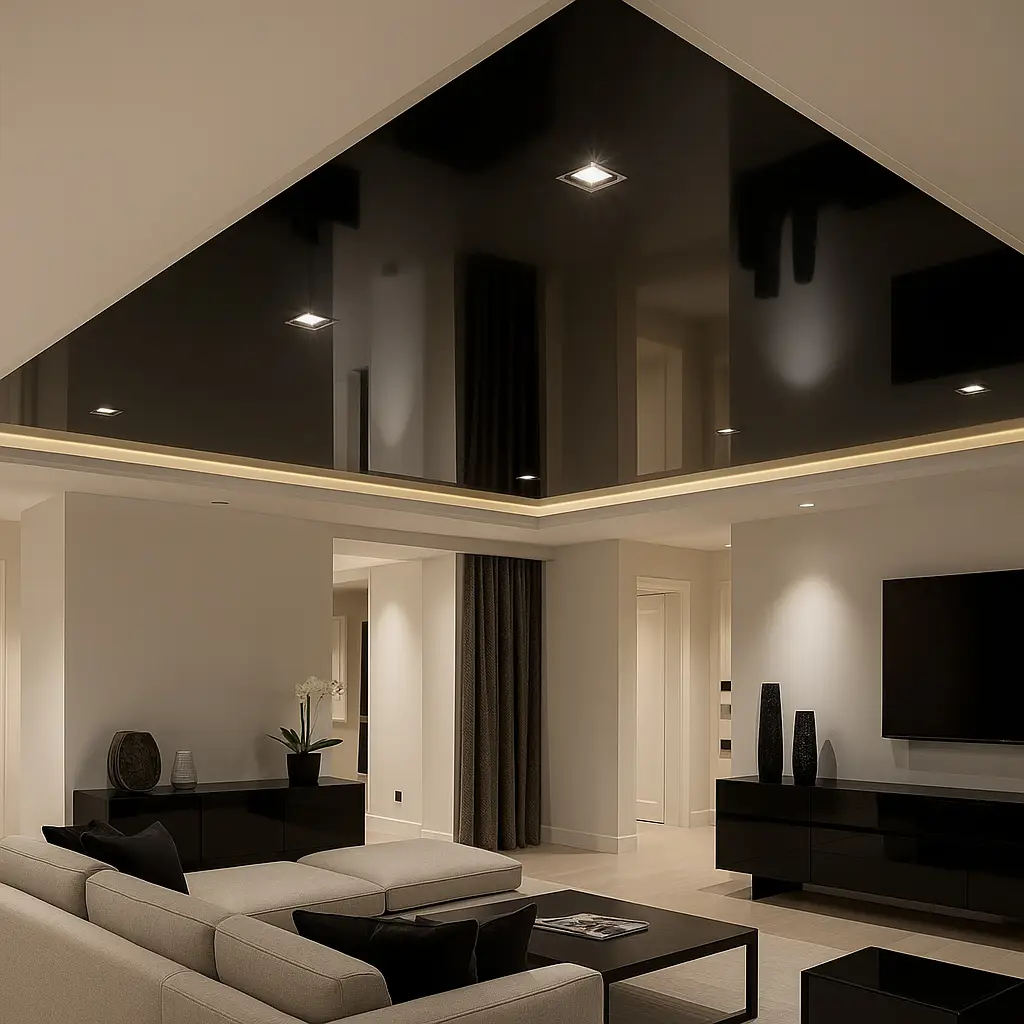
A black membrane comes in three finishes, and it is the finish, not the colour itself, that decides how the room is perceived. The comparison is qualitative – the figures depend on the specific film and are given by its manufacturer.
| Feature | Matt | Satin | Gloss (lacquer) |
|---|---|---|---|
| Reflections | None – the surface absorbs light | Soft, diffused | Mirror-like – furniture, windows and every light source are visible |
| Perceived height | Unchanged; the ceiling “closes” the room from above | Slightly brightened | The reflection visually doubles the height |
| Dust and streaks | Barely visible | Moderately visible | Visible against the light – every streak and speck |
| Small membrane waves and installation marks | Masked by the matt surface | Partly visible | Visible at an angle, in the reflection |
| Lighting | Needs more light, as it gives nothing back | In between | Reflects the fittings – every light source exists twice |
| Typical rooms | Bedrooms, home cinemas, studies | Living rooms, corridors | Low rooms, staircases, representative areas |
Gloss gives the most spectacular result – the room is reflected in the ceiling and visually gains a second height – but a mirror is unforgiving: it shows the slab above the window, the clutter on top of the wardrobe, dust and every streak left after cleaning. Matt works the other way round: it absorbs light and hides imperfections and marks, but it needs carefully planned lighting, because the ceiling gives nothing back to the room. Satin is the compromise most often chosen by clients who want to avoid the extremes.
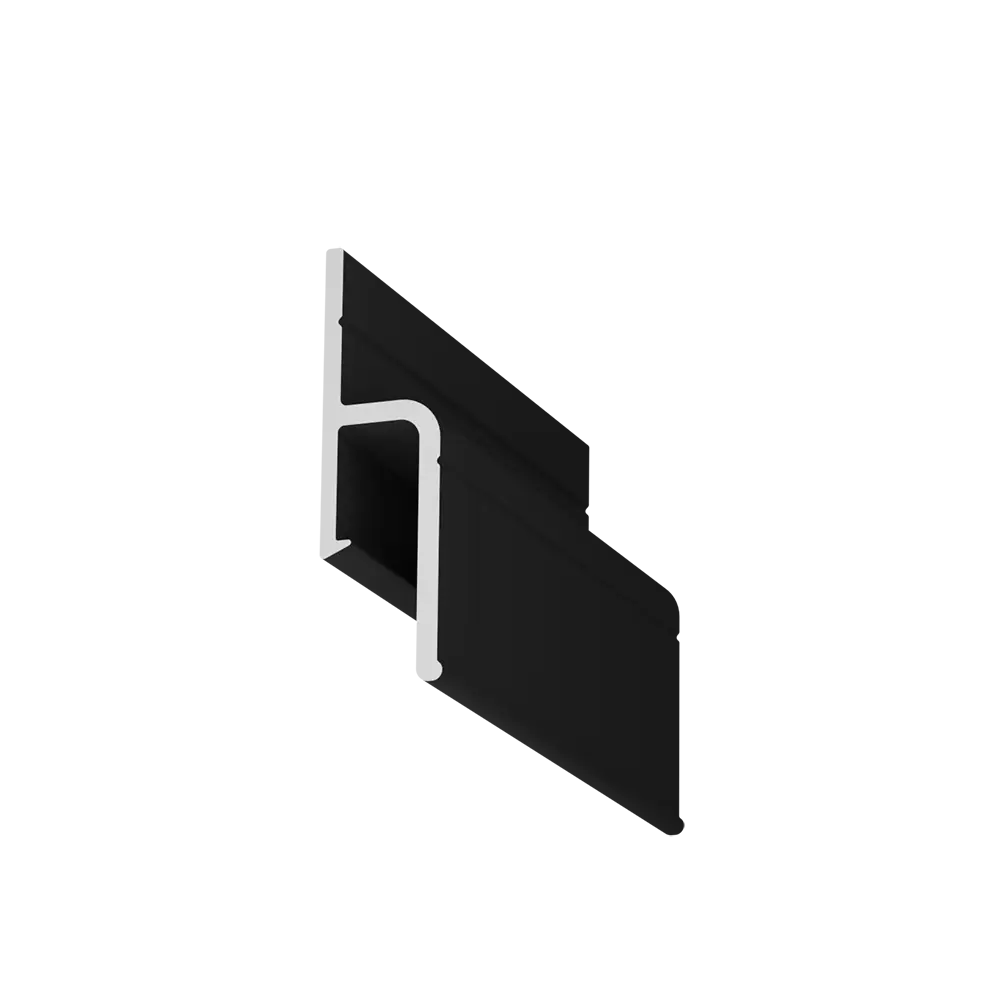
With a white ceiling the colour of the profile does not matter – the edge disappears into the white. With a black membrane, every light-coloured element on the perimeter – the visible lip of the wall profile, a white harpoon, a silver separator – draws a bright line along the wall. That is why a black ceiling is fitted with components powder-coated black.
According to the product cards, the following items in the 2K-Trade catalogue have a “black (RAL-9005)” variant:
The number in a CLASSIC name is approximately the mass of one running metre of the raw profile in grams (CLASSIC 125 ≈ 125 g/m, CLASSIC HARD ≈ 170 g/m according to the cards), not the distance from the slab – CLASSIC 125 and CLASSIC 200 have the same height of about 32 mm. They differ in wall thickness and stiffness: CLASSIC 125 → CLASSIC HARD → CLASSIC 200. The stiffer the profile, the better it holds the membrane tension on long straight runs and in large rooms; the choice belongs to the installer, not to a table. Painted versions weigh slightly more than raw ones. How far the ceiling sits below the slab is decided by the mounting type (wall or ceiling profile) and by the installation itself – with a wall profile it is a few centimetres: the profile height plus the installer’s margin. In the GAMMA series the number means something else: the approximate width of the light line in millimetres.
A black ceiling most often meets the wall with a shadow gap instead of a masking seal – a dark line along the wall looks natural, whereas a light-coloured seal would spoil the effect. The options are:
A large black ceiling, or a black field joined to a white one, is made with the GAMMA 10 separator: the narrowest profile in the series, fixed to the ceiling on brackets, about 350 g/m, available in black RAL 9005. It is a membrane separator, not a lighting profile – we do not design light lines in GAMMA 10; that is what GAMMA 20, 30 and 50, described below, are for.
The membrane is fixed in the profile with a harpoon. For a black ceiling there is the black G-1 harpoon made of TPE (500 m roll, left- and right-hand versions); the double-sided TWIN SIDE harpoon is also available in black. A white harpoon on a black membrane leaves a bright line around the whole perimeter.
A black membrane does not return light to the room, so lighting that worked “on the side” with a white ceiling – bounced off the ceiling – will not work here. The light has to be delivered directly: with light lines, spotlights or wall lighting.
A light line in a GAMMA profile gives the cleanest effect on a black background: a bright line without a glowing halo. The number in the name is the approximate width of the light line in millimetres; the strip channel is wider than that:
LED strips come in 8, 10 and 12 mm widths. GAMMA profiles are fixed to the ceiling slab or on brackets. For a black ceiling the black diffusers DH-G.30.BL and DH-G.50.BL are useful (black translucent polycarbonate, 50 m roll): a switched-off line is invisible on the black membrane, and a switched-on one lights normally. White diffusers, by contrast, draw a bright stripe on a black ceiling even when switched off – sometimes that is intended, but it has to be known before ordering.
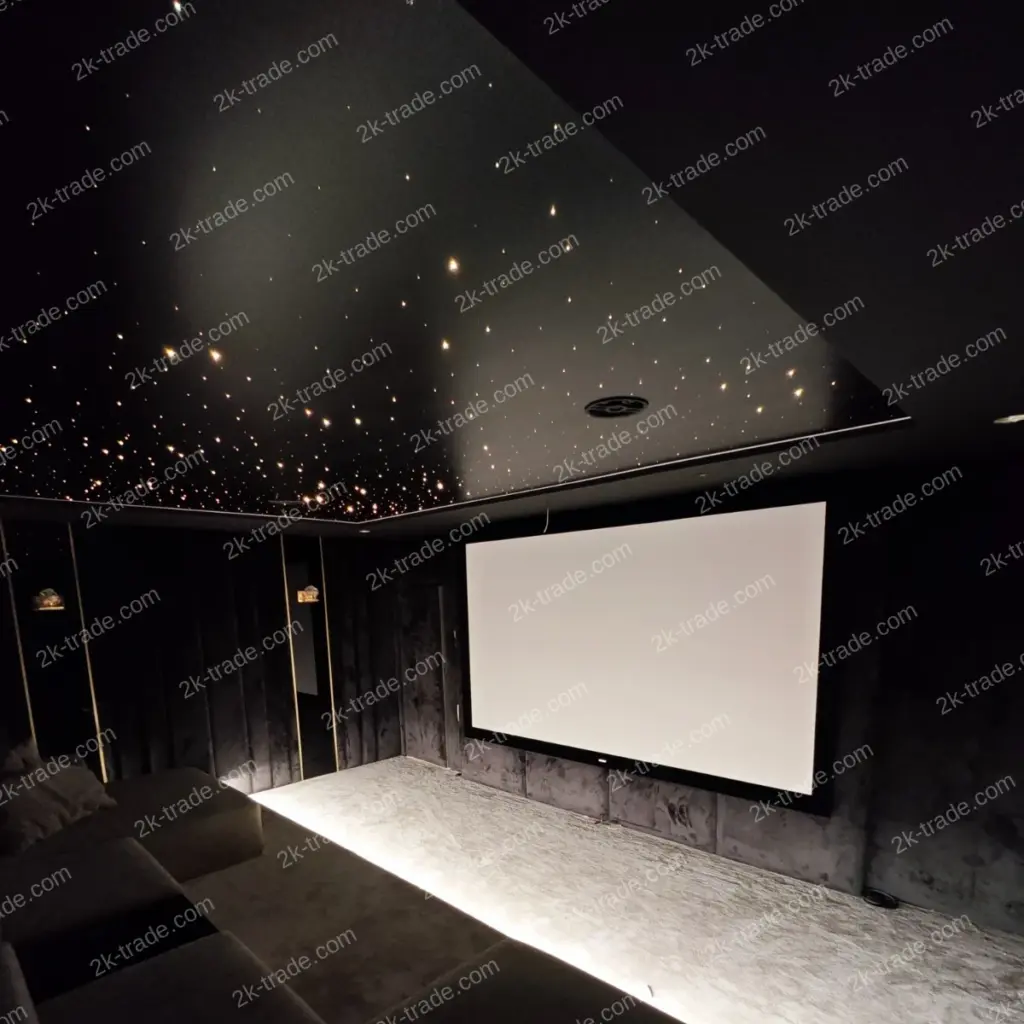
Spotlights do not hang on the membrane. Under each fitting a platform is fixed to the slab, and the hole in the membrane is reinforced with a ring – both are in the platforms and rings category. On black gloss the fitting and its reflection are both visible, so the body of the fitting and its visible rim should be black or hidden in shadow. Backlighting a black membrane with LED modules gives a weak effect – dark film lets little light through – and we leave that technique to light-coloured membranes. A starry-sky effect on black gloss is made with fibre optics, for example the Starsky pins; we describe it in the article on fibre-optic lighting.
On lacquer every light source exists twice: the fitting and its mirror image. The diodes of a strip without a diffuser are reflected as a row of dots, which is why light lines on gloss are designed only with a diffuser. Spotlights are aimed at the walls, not at the ceiling – gloss will not diffuse the light, it will only show the reflection of the fitting. Matt has none of these constraints, but it needs more light sources, because the ceiling gives nothing back.
The projects below were carried out by the installation company GRAF Ceilings & Walls / ANVAPOL (sufitynapinane.eu) with materials from the 2k-trade.com catalogue. The prices are the partner’s indicative prices including material and installation.
Gloss – no: the mirror reflection visually doubles the height, which is exactly why black lacquer ends up in staircases and low rooms. Matt – it depends on the light: with well-lit walls a dark ceiling “disappears” and does not weigh on the room, while in a poorly lit room a low matt ceiling brings the interior down. Satin behaves in between.
PVC membrane does not absorb moisture and is used in bathrooms and kitchens regardless of colour. The finish makes the difference: gloss shows traces of steam and deposits, matt hides them. Choosing a specific membrane for a room is a matter for its manufacturer and the installer.
A dry microfibre cloth for dust; for streaks, a slightly damp microfibre cloth with a mild detergent, then wipe dry. No abrasives, rough sponges or solvents.
Powder-coated black (RAL 9005): wall profiles CLASSIC 125, CLASSIC 170, CLASSIC HARD or CLASSIC 200, ceiling profiles CLASSIC-SU 125, CLASSIC-SU 155 or CLASSIC-SU HARD. A shadow gap is given by the CLASSIC profiles (8 mm) and SOMBRA (6 mm); no-drill installation – DELTA BOX. The stiffness grade is chosen by the installer for the run lengths and the size of the room.
The price depends on the membrane finish and on the project – the number of corners, fittings and light lines – not on the colour as such. Our installation partner quotes indicative prices on sufitynapinane.eu from PLN 110/m² including material and installation; the black projects described above were priced from PLN 180 and from PLN 220/m². Components from 2K-Trade are priced B2B on request.
Author: MB 2K-Trade
Comprehensive guide to stretch ceilings: membrane materials (PVC, polyester fabric), surface finishes (matte,
A 3D stretch ceiling is a printed translucent membrane tensioned on aluminium profiles
A black stretch ceiling is a PVC or fabric membrane in black, mounted