A starry-sky effect in a stretch ceiling can be made in three ways: with Starsky fibre-light pins fed by an LED strip or LED modules above the membrane (per the product card they need about 5 cm of free space; packs of 250 and 500), with a fibre-optic bundle and an LED light engine from our range (RGB+CCT 16 W and 30 W, RGBW 50 W, fibre on reels and a ready-made bundle), or with a printed membrane backlit by modules. The article compares the methods qualitatively and shows which membrane gives the best contrast.
A “starry sky” is one of the more frequent client wishes for a stretch ceiling in a bedroom, a child’s room or a spa area. The installer can choose between three techniques that differ in light source, in the space needed above the membrane and in labour. This article describes all three but gives most room to the Starsky fibre-light pins from the 2K-Trade catalogue, because they are the ones that come up most often in questions. We state only the parameters that are on the product card.
Three ways to a starry sky
Starsky fibre-light pins – individual elements of transparent light-conducting material that pass through the membrane; the light comes from an LED strip or LED modules placed above the ceiling.
Fibre-optic bundle with an light engine – the classic system: one light source in a projector, hundreds of fibres routed above the membrane, only their ends visible.
Membrane with a “starry sky” print – an image of the sky printed on the membrane and backlit from above by LED modules; the light points are print, not separate elements.
The methods can be combined: the print gives the background of nebulae, and pins or fibres give distinct, glowing stars in the foreground.
Method 1: Starsky fibre-light pins
According to the product card, Starsky pins are made of a transparent light-conducting material that disperses LED light; they are compatible with LED strips and LED modules, with white and RGB lighting, and their installation needs only about 5 cm of free space above the ceiling. They work with stretch ceilings, plasterboard and other materials up to 15 mm thick and require no special optical equipment. They are sold in packs of 250 and 500 pieces. That is the complete set of data we have; the number of pins per square metre, the spacing and the strip power are set by the installer for the specific project.
How it works in a stretch ceiling
The principle is simple: above the membrane, in the space between the slab and the ceiling, an LED light source works – an LED strip or LED modules at 24 V. The “star” points are planned on the membrane, the pins pass through it and conduct the light from top to bottom; from the room only the glowing tip is visible. There is no projector and no fibre bundle to route – which is exactly why about 5 cm above the membrane is enough where the classic system needs room for an light engine.
In installation practice the order is: first lay out and connect the light source above the future ceiling, then stretch the membrane, and finally place the pins according to the plan.
Power and control
Power and control – as per the product card. The strip or modules run at 24 V from an LED power supply matched to the power of the installation, and a controller handles dimming and – with an RGB strip – colour. The power supply and controller are placed where they can be reached after the ceiling is closed, for example in an access hatch or in an adjacent room. The choice of 12 V/24 V power supplies is covered separately in the article How to choose a 12 V/24 V LED power supply.
Method 2: fibre-optic bundle with an LED light engine
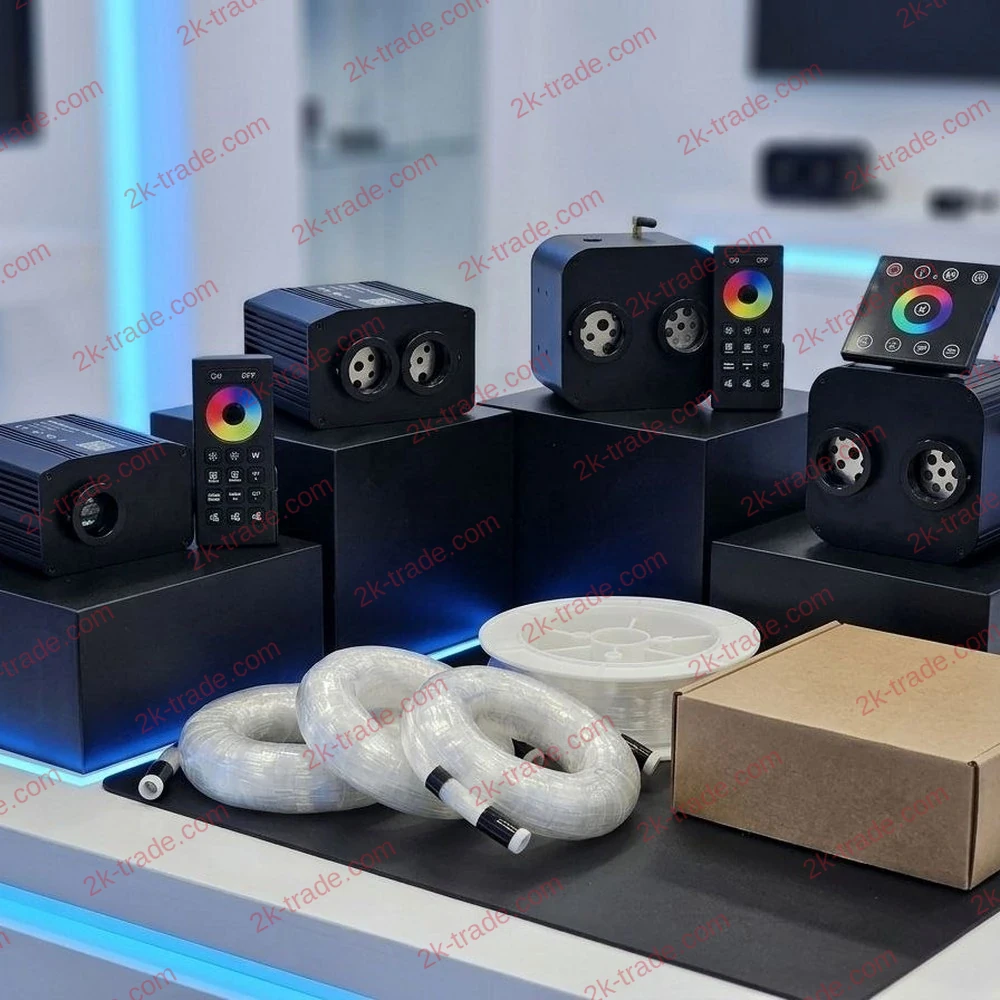
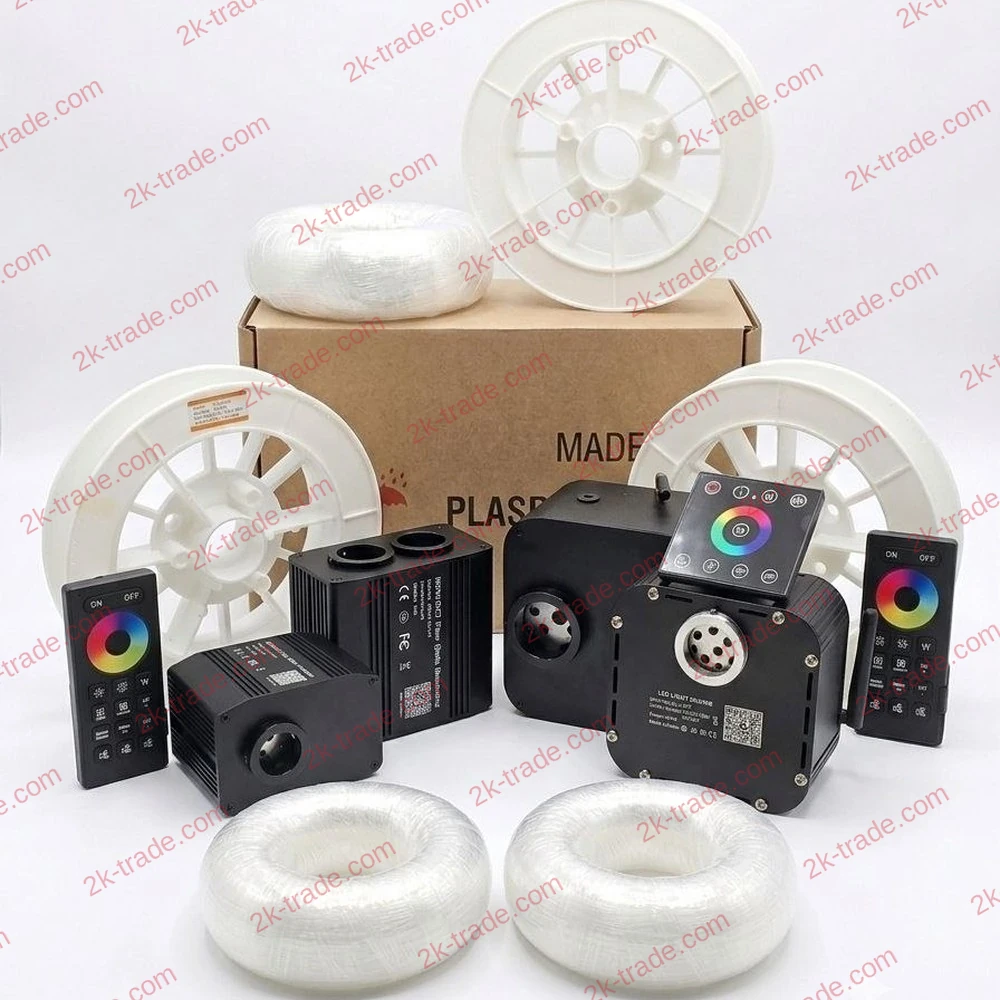
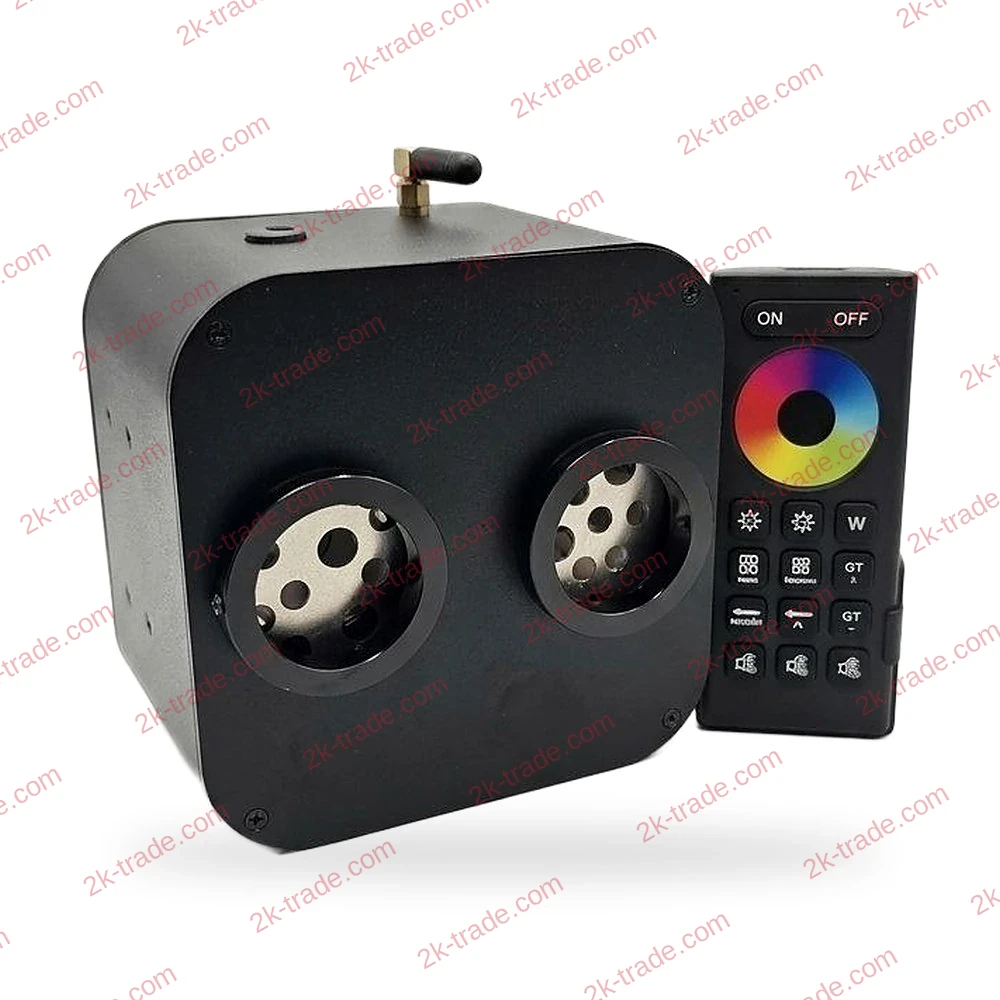
This is the solution the whole starry-sky technique started with – and since 2026 we offer it again. One light source – a fibre optic LED light engine hidden above the ceiling – feeds a bundle of fibres; each fibre is routed above the membrane to its planned point, pulled through a hole and trimmed. From the room only the ends are visible, and they carry neither current nor heat. Our light engines have an RGB+CCT (16 W and 30 W) or RGBW (50 W) LED source, a twinkle effect, and control by remote, wall panel and app; Ø 0.75 mm and Ø 1.0 mm fibres come on reels (2700 m and 1500 m) and as a ready-made bundle of 550 fibres × 4 m – all in the fibre optic lighting category. How to match the light engine to the number of stars and the route lengths is in our guide Fibre optic star ceiling – how to choose the light engine and fibres.
Where to mount it: according to the manual the light engine is an indoor device – it is not installed in damp places or where exposed to water, and above the ceiling it needs ventilation and service access. Ask us before ordering about use in a bathroom or a sauna. The advantage of no current at the fibre ends remains – the ceiling holds only fibre ends, all the electronics are in the light engine.
The cost of this method is above all labour: routing several hundred fibres above the ceiling takes time, and the light engine needs room and service access. In return the installer has full control over the placement and brightness of every point.
Method 3: printed membrane with module backlighting
Membrane manufacturers offer a “starry sky” print – nebulae, the Milky Way, scattered stars. The printed membrane on its own is a picture; the glow comes from backlighting from above with LED modules that spread the light evenly over the whole surface. 2K-Trade does not sell membranes – the installer orders the print from the membrane manufacturer – but we do supply the LED modules, power supplies and controllers for the backlighting. The method gives no individual sharp points of light; what it gives is a background on which Starsky pins or optical fibres look best.
Comparison of the three methods
The comparison is qualitative – the numbers depend on the project, the membrane and the components chosen.
Feature
Starsky pins
Fibre-optic bundle
Print + LED modules
Light source
LED strip or modules at 24 V above the membrane
LED light engine, one source for the whole bundle
LED modules above the membrane
Space above the membrane
About 5 cm (per card)
Room for the light engine and fibre routing
Depends on the modules and the evenness required
Character of the effect
Distinct points, colour per strip (white or RGB)
Points of varying brightness, twinkle and colour change from the light engine
Diffuse background, no sharp points
Labour
Placing the pins after the membrane is stretched
Routing every fibre above the ceiling
As with any module backlighting
Service
Access to the power supply and controller
Access to the light engine
Access to the power supply and controller
Hot zones (sauna)
No – an element of a stretch ceiling
Light engine for indoor use, not in damp places (per manual) – ask before ordering
No – PVC membrane
Membrane, profiles and an installed example
The best contrast comes from a black gloss membrane: the points shine against a dark background and reflect in the lacquer, and the room visually gains depth. The profiles, harpoon and diffusers for a dark ceiling – the black versions from the catalogue – are described in the article Black stretch ceiling from 2K-Trade; it also covers what not to do on gloss (for example an LED strip without a diffuser).
What such a ceiling looks like after installation is shown by the photo of a starry-sky bedroom in the project gallery of our installation partner (GRAF Ceilings & Walls / ANVAPOL): black gloss with point lighting – sufitynapinane.eu/realizacje. It is the partner’s installation, not 2K-Trade’s; the components come from our catalogue.
Frequently asked questions
Do Starsky pins need a fibre-optic projector?
No. According to the product card the pins are compatible with LED strips and LED modules, white and RGB – the light source is placed above the membrane and the pins conduct it into the room. A projector and a fibre bundle are a separate, classic method.
How much space above the membrane do Starsky pins need?
The product card gives about 5 cm of free space. A classic fibre-optic system needs more – room for the light engine and for routing the fibres.
Are optical fibres suitable for a sauna?
According to the manual the fibre optic light engine is an indoor device and is not installed in damp places or where exposed to water; ask us before ordering about use in a sauna or a bathroom. Starsky pins are an element of a stretch ceiling and are not intended for hot zones.
Can a starry sky be made on a light membrane?
It can, but the contrast is lower than on a dark one. The best effect comes from a black gloss membrane – the points shine against a dark background and reflect in the surface.
We have resumed sales of fibre optic star ceiling kits. How to choose the light engine (16, 30, 50 W), how many Ø 0.75 and Ø 1.0 mm fibres it feeds, reel or ready-made bundle, a worked example, installation and net prices.
To provide the best experiences, we use technologies like cookies to store and/or access device information. Consenting to these technologies will allow us to process data such as browsing behavior or unique identifiers on this site. Not consenting or withdrawing consent may adversely affect certain features and functions.
Functional
Always active
Przechowywanie lub dostęp do danych technicznych jest ściśle konieczny do uzasadnionego celu umożliwienia korzystania z konkretnej usługi wyraźnie żądanej przez subskrybenta lub użytkownika, lub wyłącznie w celu przeprowadzenia transmisji komunikatu przez sieć łączności elektronicznej.
Preferences
Przechowywanie lub dostęp techniczny jest niezbędny do uzasadnionego celu przechowywania preferencji, o które nie prosi subskrybent lub użytkownik.
Statistics
Przechowywanie techniczne lub dostęp, który jest używany wyłącznie do celów statystycznych.Przechowywanie techniczne lub dostęp, który jest używany wyłącznie do anonimowych celów statystycznych. Bez wezwania do sądu, dobrowolnego podporządkowania się dostawcy usług internetowych lub dodatkowych zapisów od strony trzeciej, informacje przechowywane lub pobierane wyłącznie w tym celu zwykle nie mogą być wykorzystywane do identyfikacji użytkownika.
Marketing
Przechowywanie lub dostęp techniczny jest wymagany do tworzenia profili użytkowników w celu wysyłania reklam lub śledzenia użytkownika na stronie internetowej lub na kilku stronach internetowych w podobnych celach marketingowych.