Stretch Ceiling Accessories and Tools: Complete Installation Guide
Practical guide to stretch ceiling accessories and tools: platforms, reinforcing rings, harpoons, gaskets,





25.07.2025 | Installation Guides

Looking for FROTH and wondering what hides behind the name? On the construction market it is shorthand for the original Froth-Pak insulation foam by DuPont – a portable spray system used to create an airtight thermal and acoustic envelope in record time. In this article we look exclusively at the original kits supplied in 180, 600 and 1900 litre packs. You will learn how the Quick Rise (fast expansion) and Slow Rise (slow expansion) versions differ and how to work safely with two-component PUR foam.
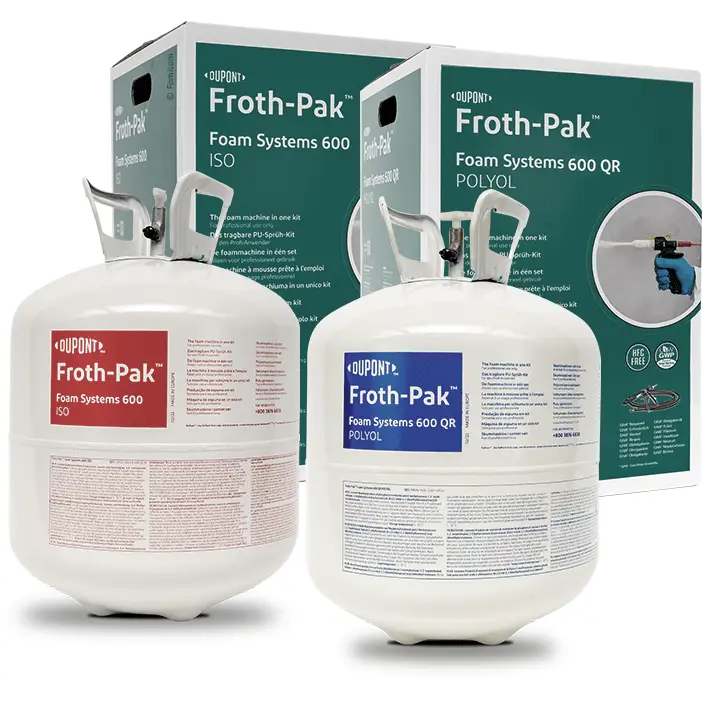
Froth-Pak is a system built around two pressurised cylinders – one holding the isocyanate component, the other the polyol. The two react inside the spray gun and form a rigid, closed-cell polyurethane foam. The manufacturer, DuPont, points out that the new HFO-based formulation has a very low global warming potential (GWP). The kits are designed for fast insulation work: heat the cylinders, connect them to the gun and spray the foam without any external compressor. According to the manufacturer’s technical data sheet, the foam has a thermal conductivity (lambda) of ≤ 0.022 W/(m·K), which corresponds to an R-value of around 0.45 m²·K/W per cm of thickness – so even a relatively thin layer delivers good thermal protection.

Every Froth-Pak kit available in the 2K-Trade shop comes with two pressurised cylinders (single-use in the 180 and 600 versions, refillable in the 1900 version), the necessary hoses, a spray gun and a set of nozzles for different applications. The white cone nozzles are intended for standard spraying, the blue ones lay down a thin film, the green ones fill cracks and crevices, and the black ones are used to pour foam into larger cavities. The nozzles fit onto the spray gun and ensure even mixing of the two components. There are two formulations to choose from: Quick Rise (QR) – fast expansion – and Slow Rise (SR) – slow expansion. The QR version is tack-free in just 30 seconds and reaches full strength after about 5 minutes. The SR version takes around 70 seconds to take shape and roughly 8 minutes to cure fully, which gives the foam more time to flow into and fill enclosed spaces.
High insulation performance. Thanks to its low lambda value and high R-value, Froth-Pak insulates well even in a thin layer. According to the manufacturer, up to 95 % of the structure consists of closed cells, which makes the foam resistant to moisture and reduces condensation.
Fast installation, no extra equipment. No compressor, no power supply – simply heat the cylinders, connect the hoses and spray. The Quick Rise version cures in about 5 minutes, significantly cutting build time on site.
Versatile adhesion. The foam bonds to most substrates, including timber, concrete, steel, plasterboard and masonry, with the exception of a few plastics such as PE film and PTFE. It is waterproof and can also be used in cryogenic insulation.
Choice of formulation. Quick Rise (QR) is well suited to surface insulation – walls, roofs and lofts. Slow Rise (SR) is designed for filling enclosed cavities, for example in steel structures or OEM applications.
HFO-based formulation. The new recipe uses HFO blowing agents instead of HFCs, which according to the manufacturer greatly reduces the climate impact. The foam contains no formaldehyde or ozone-depleting substances.
The table below summarises the key parameters of the three standard Froth-Pak kits. The data comes from the manufacturer’s (DuPont) technical data sheet and the product cards in the 2K-Trade catalogue.
| Pack | Type | Expanded foam yield | Kit volume | Coverage at 5 cm | Gross weight | Application |
| Froth-Pak 180 | single-use | 375–430 l | ≈ 0.4 m³ | ≈ 8 m² | ~17 kg | Small projects and repairs, insulation around windows and thermal bridges |
| Froth-Pak 600 | single-use | 1250–1430 l | ≈ 1.3 m³ | ≈ 26 m² | ~25 kg | Mid-sized jobs – roofs, lofts, walls |
| Froth-Pak 1900 | refillable | 3900–4500 l | ≈ 4.2 m³ | ≈ 84 m² | ~95 kg | Large commercial projects, warehouses, cold stores; refillable |
The 180 and 600 packs are available in either formulation (QR or SR), while the 1900 kit is normally supplied as a refillable system in either fast or slow expansion. The manufacturer also offers a mini kit (25–35 l), but this article focuses on the standard kits.
Quick Rise (QR) – the foam reaches its target volume in around 30 seconds and is tack-free almost immediately; full cure takes about 5 minutes. This rapid reaction makes QR ideal for vertical and horizontal surfaces such as walls, lofts and ceilings. It is the formulation of choice in residential construction, where speed and the option to apply several thin layers really matter.
Slow Rise (SR) – the foam needs about 70 seconds to take shape and around 8 minutes to cure completely. The longer reaction time lets the mass flow freely inside enclosed cavities, which is why SR is the right choice for injecting walls, suspended ceilings and for industrial and OEM manufacturing. When injecting, control the pressure carefully to avoid deforming the surrounding structure.
| Parameter | Quick Rise | Slow Rise |
| Time to take shape | ~30 s | ~70 s |
| Full cure | ~5 min | ~8 min |
| Applications | Surface insulation – roofs, walls, ceilings | Filling enclosed cavities, injection |
| Advantages | Fast workflow, multi-layer application possible | Precise filling, lower risk of voids |
| Disadvantages | Short working time – requires experience | Longer cure and risk of overexpansion |
If you are looking for ready-to-use kits, browse our catalogue: Froth-Pak 180 polyurethane foam insulation kit and Froth-Pak 600. We also stock the matching accessories: gun and hose kits, nozzles and heating jackets.
Is Froth-Pak foam flammable? Yes – like any organic product, cured foam will burn in direct contact with a flame; the manufacturer’s data sheet gives reaction-to-fire class E. The foam therefore has to be protected with a finishing layer (plasterboard, render).
What are the safety rules? The manufacturer recommends reading the safety data sheet (SDS/MSDS). Wear protective clothing, goggles and a respirator, ensure good ventilation and keep the cylinders at working temperature.
Does the foam stick to every material? Froth-Pak bonds to most substrates: timber, metal, concrete and plaster. It does not, however, adhere to polyethylene (PE) or PTFE (Teflon), so any such films should be removed before spraying.
How do I work out how much foam I need? The manufacturer suggests a simple rule of thumb: surface area (m²) × insulation thickness (cm) × 10 = litres of foam, because 1 cm of foam on 1 m² is 10 l (1 m³ covers about 20 m² at 5 cm). For example, a 100 m² roof requiring 8 cm of insulation (R ≈ 3.6 m²·K/W) needs around 8,000 l of foam – for a project of this size it is worth considering a 1900 kit topped up with mini kits.
Is the foam waterproof and frost resistant? The foam is more than 95 % closed-cell and waterproof. It remains stable across a temperature range from –150 °C to +100 °C, which makes it suitable for refrigeration and cryogenic applications.
How long can a kit be stored? Single-use cylinders have a shelf life of approximately 15 months from the date of manufacture. After that, the components may begin to lose their properties.
Pros:
Cons:
According to the manufacturer’s data sheet the lambda value is ≤ 0.022 W/(m·K), which corresponds to an R-value of approximately 0.45 m²·K/W per 1 cm of thickness.
The gun-and-hose kit (GHA) includes a spray gun, hoses in 9, 15 or 30 ft lengths, nozzles, a spanner and technical petroleum jelly. All components can be cleaned and reused.
The choice depends on the area and the required insulation thickness. For small repairs, the 180 kit is enough (around 8 m² at 5 cm); for mid-sized jobs, choose the 600 (around 26 m²); for large projects and industrial applications, go with the 1900 (around 84 m²).
Heating jackets keep the cylinders at the required working temperature (around 24 °C) when the ambient is cool, which improves foam yield and quality.
Froth-Pak insulation foam is a professional solution for the rapid insulation and air-sealing of buildings. The 180, 600 and 1900 kits differ in yield, weight and refillability, but they all rely on the same HFO-based formulation with good insulation performance. Choosing between Quick Rise and Slow Rise lets you match the rate of expansion to the type of project. Before starting work, prepare carefully, wear the right personal protective equipment and follow the manufacturer’s recommendations. Used correctly, Froth-Pak delivers durable, airtight insulation – even in hard-to-reach places.
If you are planning a purchase, take a look at our Froth-Pak 180 and Froth-Pak 600 kits, along with the accompanying nozzles, gun and hose kits and heating jackets in our catalogue. That way you can pick the right kit for your project and achieve a professional result.
Author: MB 2K-Trade
Practical guide to stretch ceiling accessories and tools: platforms, reinforcing rings, harpoons, gaskets,

Wafer head screws: applications in stretch ceiling installation and lightweight steel construction, sizes
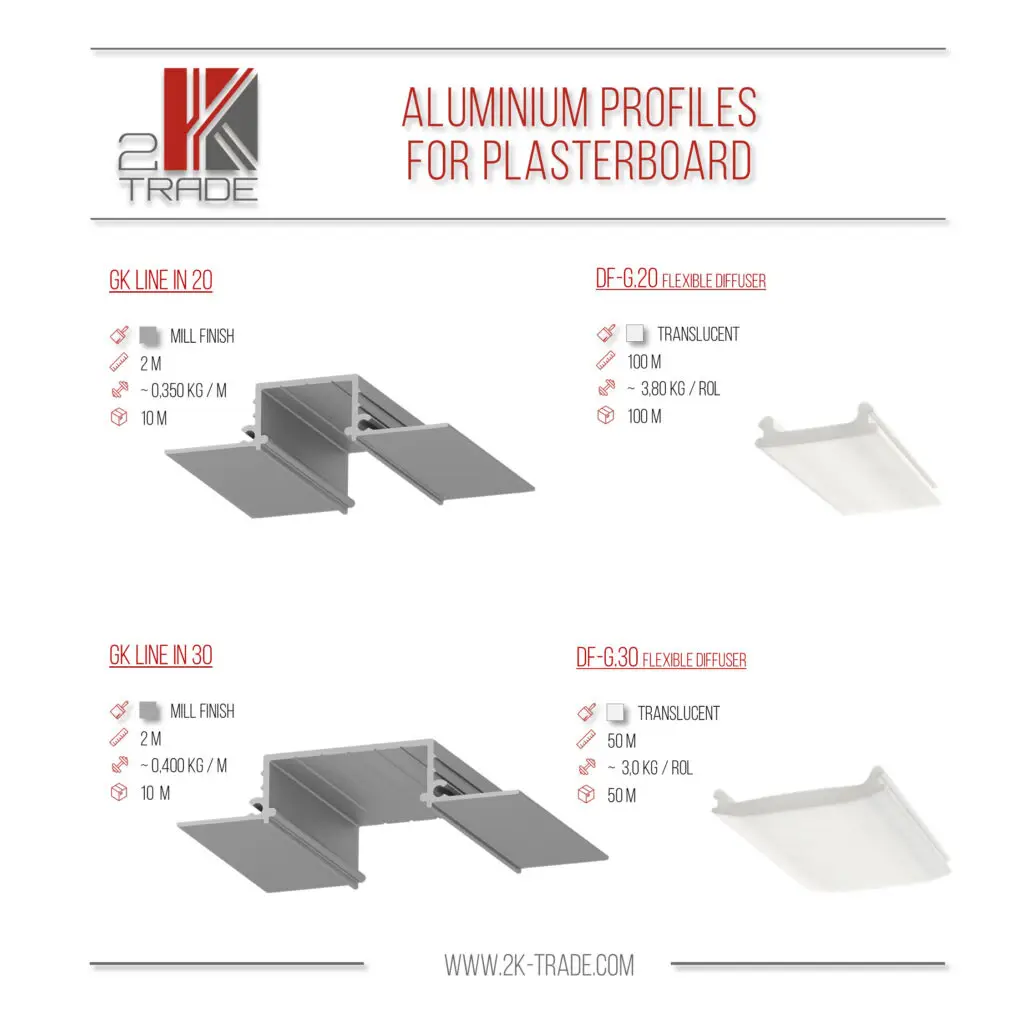
LED profiles for plasterboard are aluminium channels recessed into plasterboard ceilings and walls.