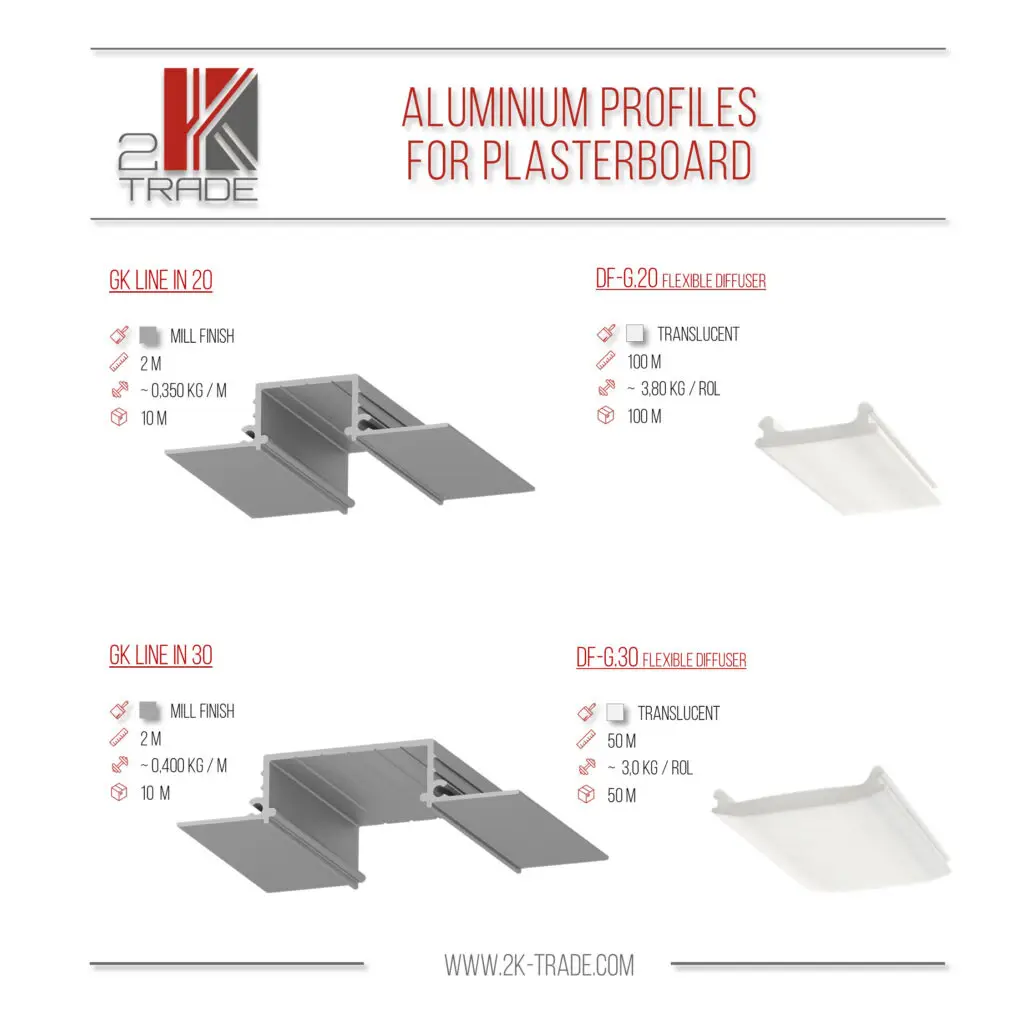
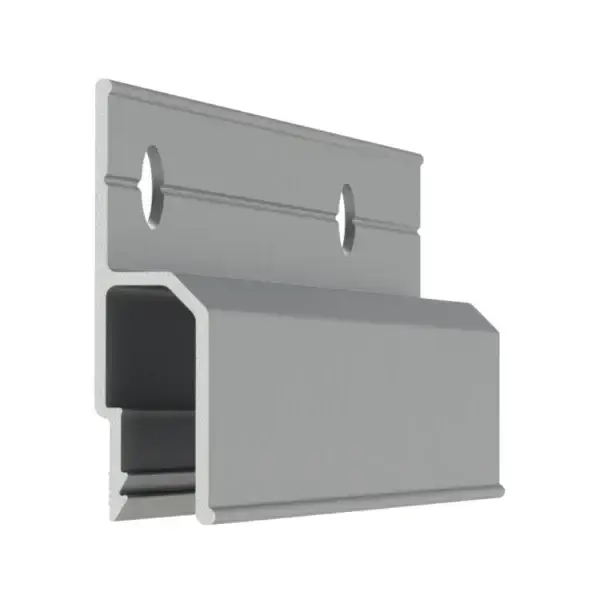
LED profiles for plasterboard are aluminium channels recessed into plasterboard ceilings and walls. The GK LINE IN series has two models: GK LINE IN 20 (20.1 mm light slot) and GK LINE IN 30 (34 mm light slot), both 14.4 mm high. The profiles are fitted during the drywall stage; after skimming and painting only a line of light flush with the ceiling or wall surface remains visible. The aluminium body draws heat away from the LED strip.
LED profiles for plasterboard (also called drywall or gypsum board) allow you to create seamless, flush light lines in suspended ceilings and wall constructions. Unlike surface-mounted profiles, plasterboard LED profiles are completely hidden inside the drywall — only the diffuser slot remains visible. This article covers the GK LINE IN series from 2K-Trade: dimensions, installation steps and compatible LED strips.
What are LED profiles for plasterboard
LED profiles for plasterboard are aluminium extrusions designed to be recessed into plasterboard constructions. Once installed, the profile body is invisible — only the light slot with its diffuser can be seen, emitting a clean line of light flush with the ceiling or wall surface. There are no protruding elements.
These profiles are used in interior and architectural projects where lighting is integrated into the building structure. 2K-Trade offers the GK LINE IN series, designed for drywall systems.
GK LINE IN series: models and specifications
The GK LINE IN series consists of exactly two models that differ in light slot width. The number in the name is the approximate width of the light line in millimetres. Both profiles are made of aluminium in a raw mill finish, share the same 14.4 mm height and are intended for plasterboard ceilings and walls.
The GK LINE IN 20 is chosen for projects where the light line should be subtle rather than dominant. Because it takes the same diffuser as GAMMA 20, a light line can continue from a stretch ceiling onto a plasterboard wall without a change in width.
LED strip: two strips side by side or one higher-output strip
Diffuser: flexible DF-G.30 or rigid DH-G.30
Application: high-intensity light lines, primary linear lighting, corridors, offices
The GK LINE IN 30 takes two LED strips side by side, including RGBW and COB types. The wider slot delivers stronger illumination and is frequently used as the primary linear light source in a room.
An end cap is also available for the GK LINE IN 30 (see other accessories); it closes the profile at the end of a run for a neat finish.
Comparison: GK LINE IN 20 vs GK LINE IN 30
Parameter
GK LINE IN 20
GK LINE IN 30
Light slot width
20.1 mm
34 mm
Overall width
62.7 mm
73.6 mm
Height
14.4 mm
14.4 mm
Flange
12.4 mm
12.4 mm
Weight
approx. 0.350 kg/m
approx. 0.400 kg/m
LED strips
one 8–12 mm strip
two strips side by side or one higher-output strip
Diffuser
DF-G.20 (flexible)
DF-G.30 (flexible) or DH-G.30 (rigid)
Length / packing
2 m / 10 m
2 m / 10 m
Typical use
Accents, perimeter
Primary linear lighting
How to install GK LINE IN profiles in plasterboard
GK LINE IN profiles must be planned into the drywall construction from the start. The profile is fitted before skimming and painting.
Step 1: Plan the profile route
Determine where the light line will run on the ceiling or wall. Profiles are installed in straight lines or at 90-degree angles (with mitre cuts). Plan the cable exit point for the LED power supply.
Step 2: Cut the slot in the plasterboard
Cut a slot in the plasterboard sized to the profile body — the profile dimensions are given on the product card. The slot must be straight and even along its entire length. Use a hand router with a guide fence or an oscillating multi-tool.
Step 3: Mount the profile
Set the profile into the slot and screw it to the metal substructure (the CD/UD channels of the MF ceiling grid). The top edge of the profile must be flush with the plasterboard surface. After fixing, fill the joint between the profile flange and the board with jointing compound, and mask the slot with painter’s tape before the ceiling is painted — the inside of the channel must stay unpainted, otherwise the LED strip bonds poorly and the aluminium dissipates heat less effectively.
Step 4: Install the LED strip and diffuser
After finishing works (skimming, painting), stick the LED strip into the profile channel and press in the diffuser. Connect the cables to a 24 V DC power supply and controller (if required).
Advantages of GK LINE IN profiles over alternatives
GK LINE IN profiles offer several important advantages over other methods of installing LED lighting in plasterboard:
Heat dissipation — the aluminium profile draws heat away from the LED strip, which a strip stuck directly onto plasterboard cannot do.
Mechanical protection — the profile shields the strip from damage during finishing works and everyday use.
Strip replacement — if the strip fails, remove the diffuser, replace the strip and press the diffuser back in. No need to disturb the drywall.
Uniform light — the diffuser eliminates visible LED dots, producing an even, continuous line of light.
Clean aesthetics — the profile is completely hidden in the construction. Only the diffuser slot is visible, delivering a minimalist finish.
Compatible LED strips
GK LINE IN profiles work with 24 V DC LED strips. The choice depends on the required brightness and function:
Can GK LINE IN profiles be installed in suspended ceilings?
Yes. GK LINE IN profiles are designed for plasterboard constructions, including suspended ceilings and walls. The profile is recessed into the board and fastened to the substructure. Installation is possible in both flat and multi-level ceilings.
What is the maximum length of a GK LINE IN profile?
GK LINE IN profiles are supplied in 2 m sections, packed in 10 m bundles. Longer light lines are achieved by joining sections end-to-end. The joint must be straight and precise so the diffuser passes smoothly between sections without a visible gap.
Can GK LINE IN profiles be used in bathrooms?
The aluminium profile can be installed in a bathroom. However, the LED strip must have a minimum IP44 rating, ideally IP65. The installation zone (distance from water sources) must comply with the electrical regulations for wet rooms (HD 60364-7-701; BS 7671 in the UK).
What is the difference between GK LINE IN and GAMMA profiles?
GAMMA profiles (e.g. GAMMA 20, GAMMA 50) are designed for stretch ceilings — they are fixed to the structural ceiling or wall and the membrane is tensioned onto the profile. GK LINE IN profiles are recessed directly into plasterboard. In both series the number in the name is the approximate width of the light line in mm. GK LINE IN 20 uses the same diffuser as GAMMA 20, so a light line can continue from a stretch ceiling onto a plasterboard wall. Choose by substrate: stretch ceiling = GAMMA, plasterboard = GK LINE IN.
Can the LED strip in a GK LINE IN profile be replaced without dismantling the ceiling?
Yes, this is one of the main advantages of GK LINE IN profiles. The diffuser is pressed into the channel and can be removed by hand. Once the diffuser is off, the LED strip is accessible for replacement. There is no need to dismantle the drywall or re-skim the joint.
Ordering and availability
The GK LINE IN series and the compatible diffusers and covers are stocked in the 2K-Trade warehouse in Łódź. B2B orders ship to Poland (1–3 working days), Europe (2–9 working days) and worldwide (5–45 working days). Contact us for a quotation and technical advice.
We have resumed sales of fibre optic star ceiling kits. How to choose the light engine (16, 30, 50 W), how many Ø 0.75 and Ø 1.0 mm fibres it feeds, reel or ready-made bundle, a worked example, installation and net prices.
To provide the best experiences, we use technologies like cookies to store and/or access device information. Consenting to these technologies will allow us to process data such as browsing behavior or unique identifiers on this site. Not consenting or withdrawing consent may adversely affect certain features and functions.
Functional
Always active
Przechowywanie lub dostęp do danych technicznych jest ściśle konieczny do uzasadnionego celu umożliwienia korzystania z konkretnej usługi wyraźnie żądanej przez subskrybenta lub użytkownika, lub wyłącznie w celu przeprowadzenia transmisji komunikatu przez sieć łączności elektronicznej.
Preferences
Przechowywanie lub dostęp techniczny jest niezbędny do uzasadnionego celu przechowywania preferencji, o które nie prosi subskrybent lub użytkownik.
Statistics
Przechowywanie techniczne lub dostęp, który jest używany wyłącznie do celów statystycznych.Przechowywanie techniczne lub dostęp, który jest używany wyłącznie do anonimowych celów statystycznych. Bez wezwania do sądu, dobrowolnego podporządkowania się dostawcy usług internetowych lub dodatkowych zapisów od strony trzeciej, informacje przechowywane lub pobierane wyłącznie w tym celu zwykle nie mogą być wykorzystywane do identyfikacji użytkownika.
Marketing
Przechowywanie lub dostęp techniczny jest wymagany do tworzenia profili użytkowników w celu wysyłania reklam lub śledzenia użytkownika na stronie internetowej lub na kilku stronach internetowych w podobnych celach marketingowych.