Colour temperature of LED strips – how does light affect our space?
The colour temperature of an LED strip (in kelvin) decides whether the light in a stretch ceiling reads as warm, neutral or cool. This article explains the 2700–6500 K range and its typical uses, the CRI and R9 colour-rendering indices, colour consistency between reels (binning, SDCM), the rules for combining colour temperatures in one room, CCT strips with their controller, the choice of profile and diffuser, and the rule of thumb for sizing the power supply.
Choosing between 3000 K and 4000 K is one of the first decisions when designing light lines in a stretch ceiling, and it is hard to undo later because the strip is sealed under the membrane. Below is what an installer should settle with the client before ordering: colour temperature, colour rendering, consistency between reels, combining colours, tunable-white strips, and the profile and power supply that go with them. The families of strips (SMD, COB, CCT, RGB, digital) are covered in the article Modern LED strips — types and which one to choose.
What colour temperature is
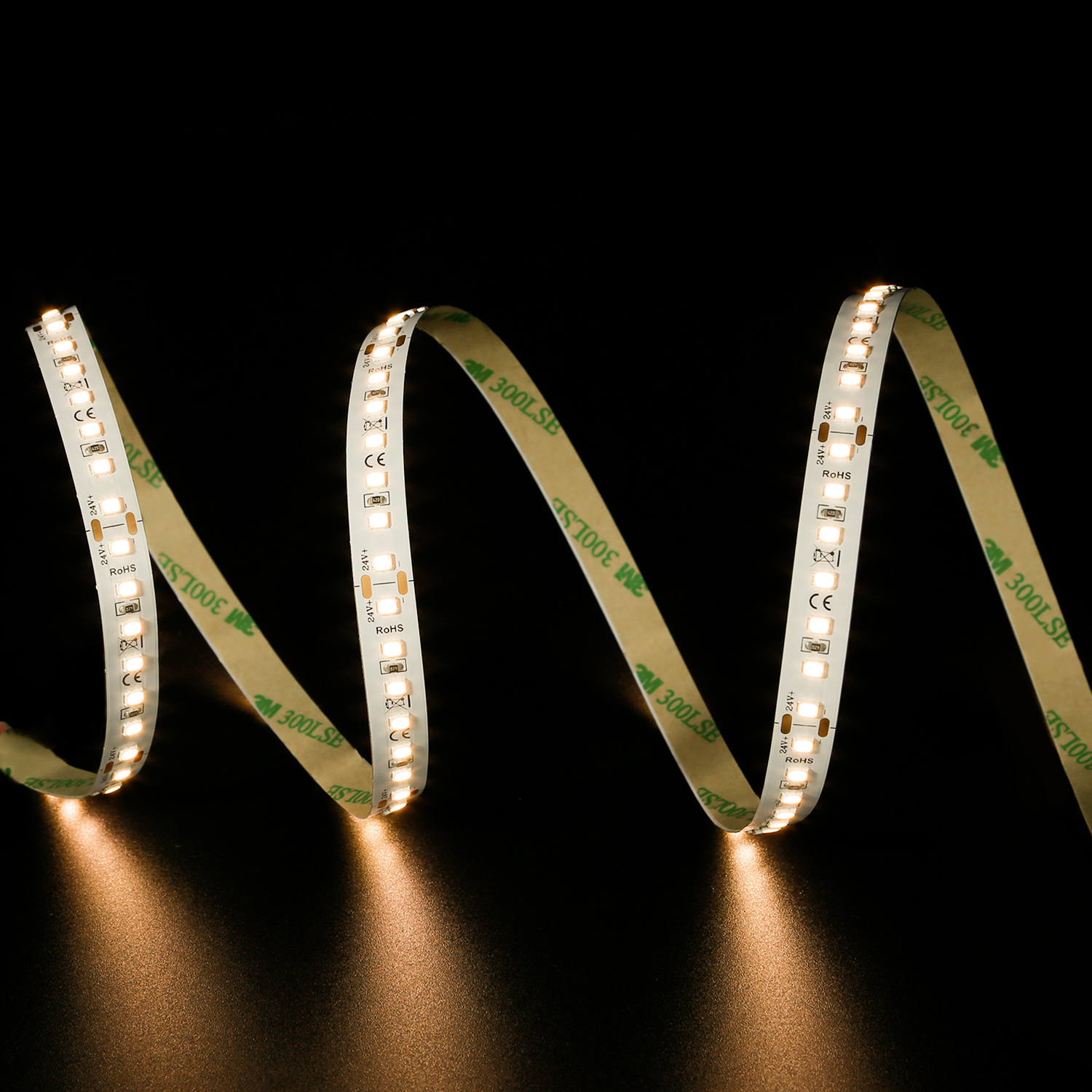
Colour temperature (CCT, correlated colour temperature) describes the tint of white light and is given in kelvin (K). The lower the value, the warmer and more yellow the light; the higher, the cooler and more bluish. In LED strips the practical range is 2700–6500 K. Three reference points are worth remembering: 2700–3000 K is warm white close to a traditional incandescent bulb, 4000 K is neutral white, and daylight corresponds only to the range of roughly 5500–6500 K. A common mistake in sales copy is to call 4000 K “daylight” — it is not; 4000 K is a neutral colour, halfway between warm and cool.
Which colour temperature for which room
There is no single correct colour temperature — there is one matched to the function of the room and its finishes. Warm light flatters wood and beige tones; neutral and cool light works better with white, grey, concrete and steel. The table sums up the typical choices from lighting practice.
Colour temperature
Impression
Typical rooms
2700 K
very warm, yellowish white, incandescent mood
bedroom, lounge area, restaurant, hotel
3000 K
warm white, cosy but crisper than 2700 K
living room, dining room, hallway, perimeter cove lighting
In the 2K-Trade catalogue, fixed-colour strips come in 3000 K, 4000 K and 6000 K — for example the LED strip 140 LED/m 24V SMD-2835 IP20 (4.8 / 9.6 / 14.4 W/m) and the LED COB 320 LED/m 24V IP20 (10 / 14 W/m). The 6000 K variant is rarely used in homes; its place is technical rooms and displays.
CRI (Ra) and R9 — how the strip renders colours
Colour temperature only describes the tint of the white. Whether objects lit by the strip look natural is described by the colour rendering index CRI (Ra) — the average of eight test colours on a scale up to 100. In interior lighting practice Ra ≥ 80 is taken as the minimum and Ra ≥ 90 where colours matter: in the kitchen, the bathroom, at a mirror, in a shop. Ra does not include saturated red — that is covered by the separate R9 index. A low R9 makes wood, skin and food look grey; if the manufacturer states R9, check it, and if not, choose the strip with the higher Ra. CRI values are given on the product cards: the COB 320 LED/m strip has CRI ≥ 90, the COB CCT 608 LED/m strip CRI ≥ 95.
Colour consistency between reels
LEDs do not all emit identically — they are sorted into groups (binning) by colour and output. The colour spread is described with MacAdam ellipses: “3-step SDCM” means a smaller deviation than “5-step SDCM” and is practically invisible to the eye. Three rules follow for the installer: the reels for one room are ordered together, not topped up a month later; “4000 K” from two manufacturers is not the same colour, so strips from different sources are not joined in one continuous profile; in a long line visible in full, the joint between two reels is best placed in a corner or in a break of the line.
Combining colour temperatures in one room
Mixing 3000 K and 4000 K in one interior is acceptable if each colour has its own function and zone. A typical layout: a GAMMA light line at 4000 K over the worktop and table, and perimeter cove lighting at 3000 K as evening light. Two rules: colours are not mixed within one continuous element (one line, one ceiling perimeter), and zones with different colours are controlled separately so they do not light the same surface at the same time. If the same line is to be warm in the evening and neutral by day, the answer is not two strips but a CCT strip.
CCT strips and the controller they need
A CCT (tunable-white) strip carries two kinds of white LEDs on one PCB — warm and cool — and lets you set the colour smoothly within the range stated on the card. The 2K-Trade catalogue has two models: the LED strip COB CCT 608 LED/m 24 V IP20 — 16 W/m, range 2700–6000 K, CRI ≥ 95, 10 mm PCB, continuous line without dots — and the LED strip CCT 120 LED/m 24V SMD-2835 IP20 — 9.6 W/m, range 2700–6500 K, 8 mm PCB. A CCT strip does not work with an ordinary single-channel dimmer: it needs a CCT controller with two output channels that mixes the proportion of the two whites and adjusts brightness. The controller is installed between the 24 V power supply and the strip and is operated with a remote, a wall panel or an app — models are in the category Drivers for LED strips. At the extreme colour settings only one group of LEDs is lit, so the strip reaches full brightness in the middle of its range.
Profile and diffuser versus perceived colour
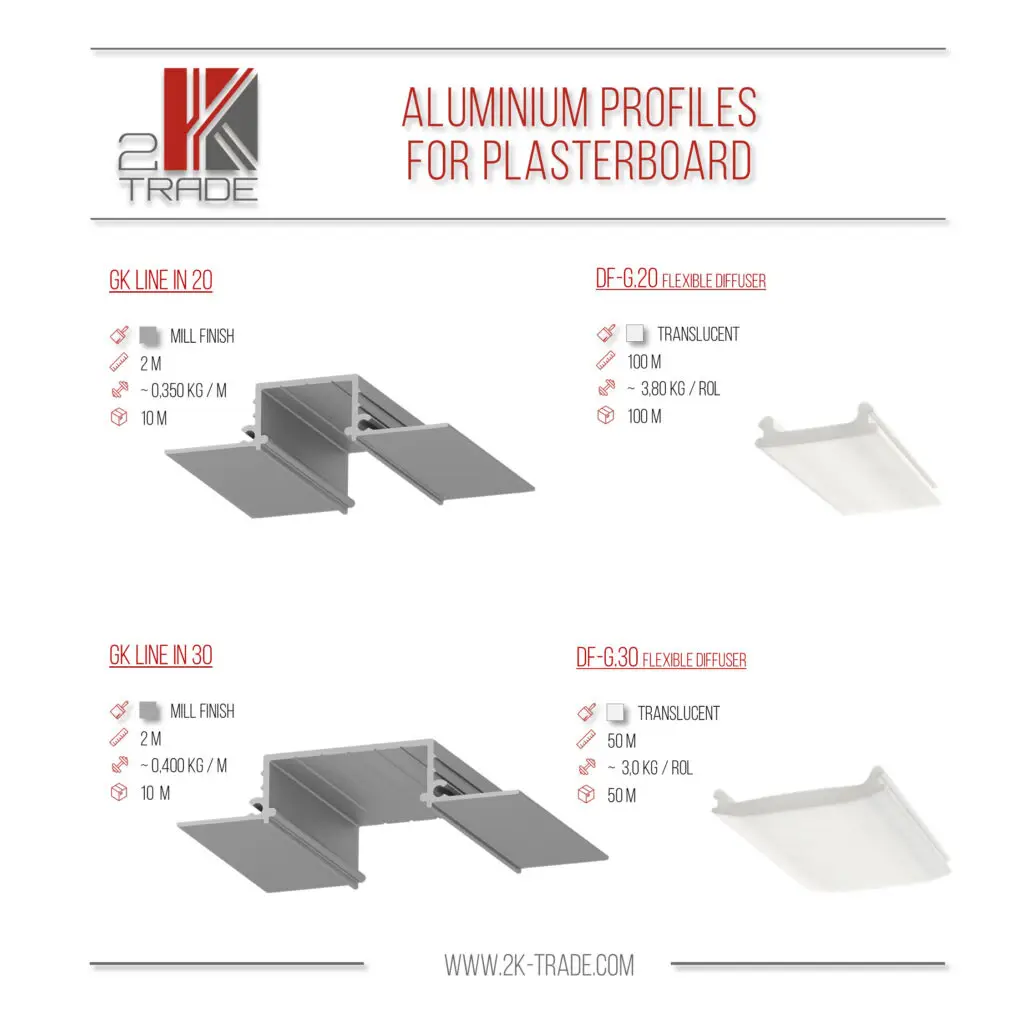
The colour of the light is only seen through a diffuser or the membrane. A milky cover diffuses the LED dots but absorbs part of the output — with the same strip, a line with a hard milky cover looks calmer, and one with a flexible cover looks brighter. In a stretch ceiling the colour is shown best by the GAMMA series profiles, where the number in the name is the approximate width of the light line in millimetres: the GAMMA 30 profile takes one or two 8–10 mm strips and works with the flexible DF-G.30 cover or the hard milky DH-G.30, which gives a uniform line about 33 mm wide; the GAMMA 20 profile makes a narrower line of about 20 mm with the DF-G.20 cover. For cove lighting at the wall there is the SIGMA-NEO LED profile with a seat for the strip, fixed to the ceiling on brackets, and for two-level ceilings the DUAL DP profile with a 20 mm flexible diffuser. A COB strip gives a continuous line without dots in each of them; an SMD strip needs a milky cover or some distance to the membrane.
Power supply for the chosen strip
Colour temperature does not change power consumption — what counts is the power from the card (W/m) and the length. Rule of thumb: power supply rating = strip power [W/m] × length [m] × 1.2, where 1.2 is a margin of about 20 %. Example: 10 m of the COB CCT 608 LED/m strip at 16 W/m is 160 W, with the margin 192 W — so a 24 V power supply rated 200 W, for example from the Mean Well XLG/ELG series (XLG 24 V – 200 W variant). With a CCT strip the controller sits between the power supply and the strip, so its rated current must also match the load. The full range is in the category LED power supplies, and sizing details, the 12 V / 24 V difference and feeding long runs are covered in the article How to choose a 12 V/24 V LED power supply.
Frequently asked questions
Is 4000 K daylight?
No. 4000 K is neutral white — halfway between warm and cool. Daylight corresponds to roughly 5500–6500 K. In homes, 4000 K is used in the kitchen, bathroom and work areas, while 5000 K and above are mainly for technical and display rooms.
Can 3000 K and 4000 K be combined in one room?
Yes, if each colour has its own zone and its own control — for example a 4000 K light line over the worktop and 3000 K perimeter lighting for the evening. Two colours are not combined in one continuous line or one circuit. If the same line is to be warm at one time and neutral at another, you need a CCT strip with a CCT controller.
Does a CCT strip work with an ordinary dimmer?
No. A CCT strip has two channels — warm and cool LEDs — and needs a CCT controller with two outputs that mixes the two whites and adjusts brightness. The controller is installed between the 24 V power supply and the strip. An ordinary single-channel dimmer will only change the brightness of one channel or will not work correctly.
Why do two reels of the same colour temperature look different?
LEDs are sorted into groups (binning), and reels from different batches or different manufacturers can differ in tint despite the same kelvin value. The spread is described as SDCM: 3-step means a smaller difference than 5-step. The strip for one room is ordered together, and reels from different sources are not joined in one line.
We have resumed sales of fibre optic star ceiling kits. How to choose the light engine (16, 30, 50 W), how many Ø 0.75 and Ø 1.0 mm fibres it feeds, reel or ready-made bundle, a worked example, installation and net prices.
To provide the best experiences, we use technologies like cookies to store and/or access device information. Consenting to these technologies will allow us to process data such as browsing behavior or unique identifiers on this site. Not consenting or withdrawing consent may adversely affect certain features and functions.
Functional
Always active
Przechowywanie lub dostęp do danych technicznych jest ściśle konieczny do uzasadnionego celu umożliwienia korzystania z konkretnej usługi wyraźnie żądanej przez subskrybenta lub użytkownika, lub wyłącznie w celu przeprowadzenia transmisji komunikatu przez sieć łączności elektronicznej.
Preferences
Przechowywanie lub dostęp techniczny jest niezbędny do uzasadnionego celu przechowywania preferencji, o które nie prosi subskrybent lub użytkownik.
Statistics
Przechowywanie techniczne lub dostęp, który jest używany wyłącznie do celów statystycznych.Przechowywanie techniczne lub dostęp, który jest używany wyłącznie do anonimowych celów statystycznych. Bez wezwania do sądu, dobrowolnego podporządkowania się dostawcy usług internetowych lub dodatkowych zapisów od strony trzeciej, informacje przechowywane lub pobierane wyłącznie w tym celu zwykle nie mogą być wykorzystywane do identyfikacji użytkownika.
Marketing
Przechowywanie lub dostęp techniczny jest wymagany do tworzenia profili użytkowników w celu wysyłania reklam lub śledzenia użytkownika na stronie internetowej lub na kilku stronach internetowych w podobnych celach marketingowych.