How to Choose a Stretch Ceiling Profile: Selection Guide
Profile selection guide for stretch ceilings: mounting method (wall or ceiling-mount SU profile),






06.04.2026 | Profiles for Stretch Ceilings
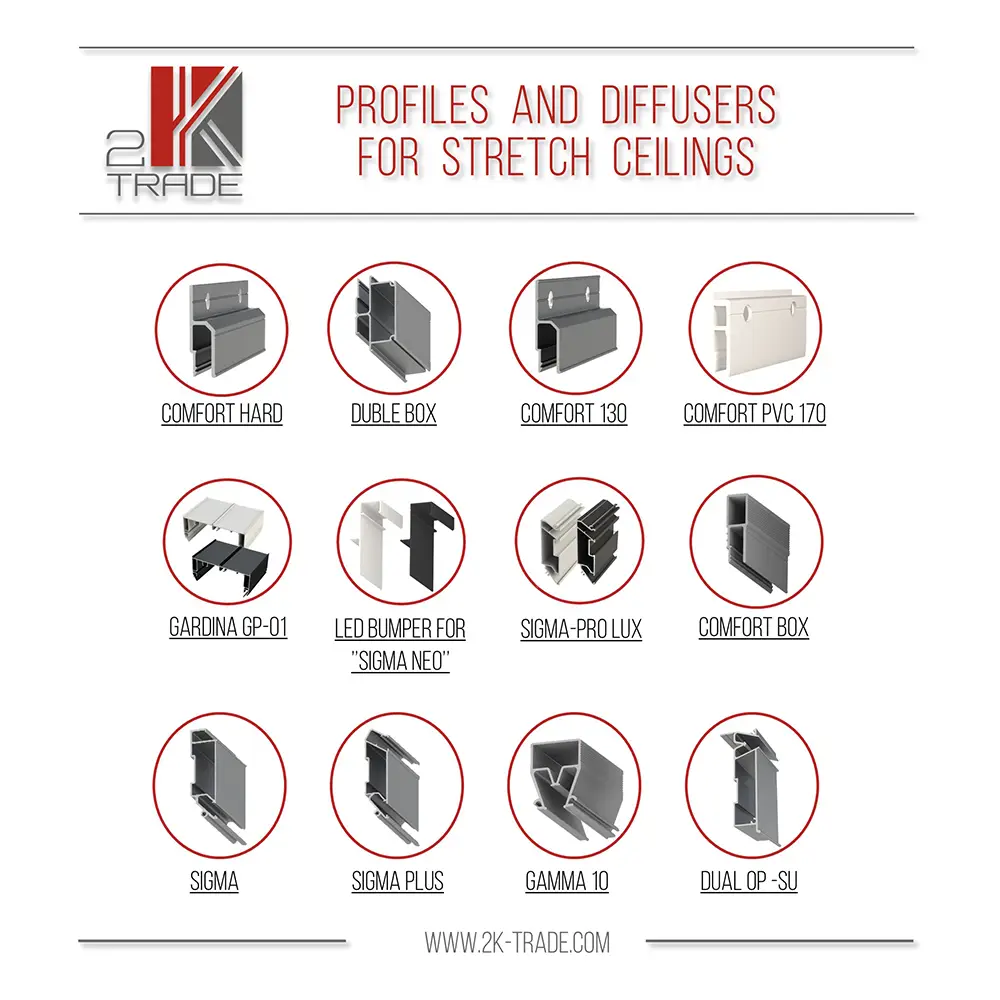

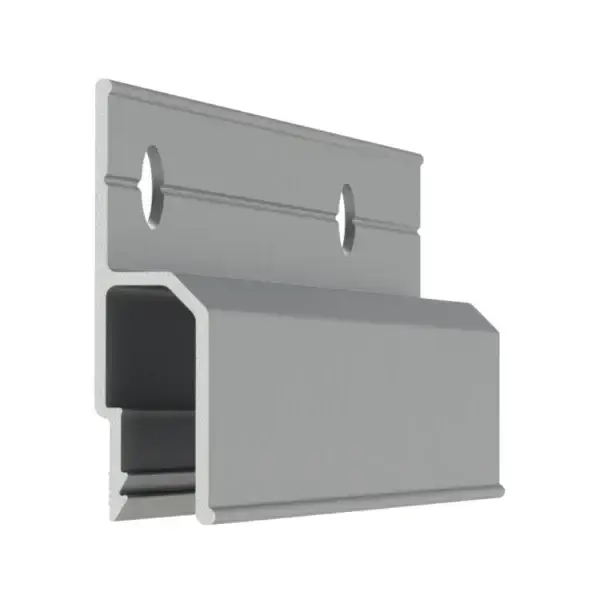
A stretch ceiling profile is an aluminium rail fixed around the perimeter of the room — to the wall or directly to the ceiling slab. The harpoon welded to the edge of the membrane locks into its channel, and the tensioned membrane forms the ceiling plane. Profiles from the 2K-Trade catalogue are sold in 2 m lengths, mill finish or powder-coated (white RAL 9016, black RAL 9005 — depending on the model).
Two naming systems coexist in the catalogue. In the CLASSIC and COMFORT series the number in the name is the approximate weight of one running metre of raw profile in grams: CLASSIC 125 weighs about 125 g/m, COMFORT 130 about 130 g/m. The height is almost the same across a series (CLASSIC 125 and CLASSIC 200 — about 32 mm, COMFORT 130 — about 31 mm); the models differ in wall thickness and stiffness. In the GAMMA and GK LINE IN series, by contrast, the number is the approximate width of the light line in millimetres.
So the number in the name does not tell you how many centimetres the ceiling will “take”. The drop below the slab follows from the mounting method and the installer’s decision; with a wall profile the loss of height is a few centimetres — the profile height (about 3 cm) plus an installation margin. A full list of dimensions for all models is given in the article Stretch Ceiling Profiles: Catalogue of Types, Dimensions and Applications; here we focus on telling the types apart and choosing a profile for the job.
Wall profiles are fixed to the wall just below the ceiling slab; this is the most widely used group in the basic profiles category.
CLASSIC profiles form an 8 mm shadow gap around the perimeter — the membrane looks as if it did not touch the wall (a “floating ceiling”). Versions: CLASSIC 125 — the lightest, with the thinnest wall; CLASSIC 170 — about 170 g/m according to the product card; CLASSIC HARD — the reinforced version of medium stiffness; CLASSIC 200 — the thickest wall and the highest stiffness, for large areas and long straight runs. Stiffness ladder: CLASSIC 125 → CLASSIC HARD → CLASSIC 200.
COMFORT profiles differ from CLASSIC in the geometry of the harpoon channel, which makes fitting and removing the membrane easier, and in the way the joint with the wall is finished: instead of a shadow gap, a decorative cover insert (sold separately) is used. Versions and minimum wall thickness: COMFORT 130 — 0.9 mm; COMFORT HARD — 1.2 mm; COMFORT 200 — 1.3 mm, the stiffest wall profile in the series. Order of stiffness: COMFORT 130 → COMFORT HARD → COMFORT 200. COMFORT 100 and COMFORT 190 have been withdrawn from the standard range (made to order) and are not included in the tables below.
The SU designation marks the versions fixed directly to the ceiling slab — according to the product cards the mounting type of every SU model is “to the ceiling”. They are used when the wall is unsuitable for fixing (tiles, glass, lightweight partitions), when there are obstacles along the wall — columns, windows, recesses, services — or when as much height as possible must be kept: COMFORT-SU 130 has a construction height of about 2 cm according to its card. SU profiles have no pre-drilled mounting holes; the installer drills them on site.
An SU profile fixed right next to the wall gives the same result as the wall version. Moved away from the wall, it lets the membrane end at any point of the slab — this is the basis for bypassing obstacles and for multi-level ceilings.
CONTOUR and CONTOUR-CLASSIC shine through the membrane fabric and sit tight against the wall thanks to a PVC seal; according to the product cards they are used only with light-coloured membranes. CONTOUR-PRO LUX has an LED strip recess closed with a flexible diffuser and gives the effect of a ceiling “hanging in a void”; CONTOUR-PRO LUX-SU is the same design for ceiling mounting, with pre-drilled holes. LED strip width according to the cards: CONTOUR 20 mm, CONTOUR-CLASSIC 15 mm, CONTOUR-PRO LUX and LUX-SU 10 mm.
The STEP profile is a wall profile with LED lighting along the walls and a 4 mm stepped transition; it is used with a 30 mm wide diffusing cover, LED strip according to the card — 10 mm.
DOUBLE-BOX is glued to the wall and/or fixed to the ceiling on steel brackets — wherever drilling into the wall is difficult: porcelain tiles, glass panels, mirrors. In the classic position it gives a shadow gap like CLASSIC, and turned over it takes a PVC seal like COMFORT. DELTA BOX is a black no-drill profile for porcelain tiles, glass and decorative panels: glued to the wall and/or fixed to the ceiling with brackets, it forms a 7.5 mm shadow gap.
For “floating” ceilings with a shadow gap around the perimeter the current profile is DELTA NEO: matt black, 2 m long, about 0.225 kg/m, 38.9 mm high, packed in 40 m. The earlier DELTA and DELTA-SU have been withdrawn from the standard range (made to order). DELTA NEO does not yet have its own product card — enquiries are taken through the basic profiles category.
Steps between planes are built on ceiling-mounted two-level profiles of the DUAL series (72.5 mm step in DUAL OP and OP-SU, 60 mm in DUAL DU, the DP version with an LED line under a 20 mm diffuser; minimum bending radius 10 cm) or on SIGMA-NEO LED from the niche profiles category.
A light line in the ceiling plane is made with LED profiles of the GAMMA series, fixed to the slab directly or on brackets, between two sections of membrane. The number in the name is the approximate width of the light line, not of the strip — the channel is much wider: GAMMA 20 (20.F and 20 SLIM variants — channel about 17 mm), GAMMA 30, 30 SLIM and 30 VERT (channel about 31 mm, two strips side by side), GAMMA 50 (channel about 45.6 mm, up to three 12 mm strips). LED strips are 8, 10 or 12 mm wide.
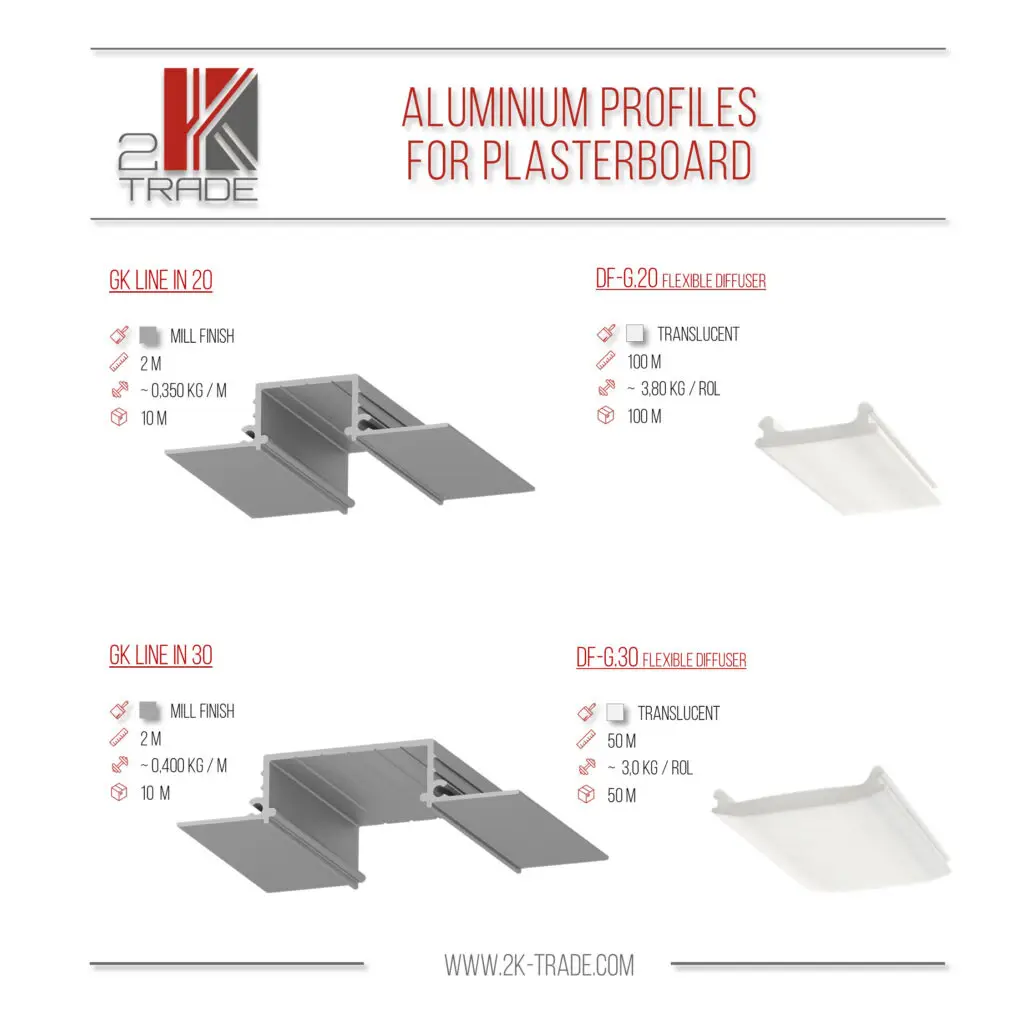
GAMMA 10 is a separator dividing two membranes, not a lighting profile — no LED strip is planned in it. When a light line is to continue onto a plasterboard wall, GK LINE IN 20 is used with the same diffuser as GAMMA 20. CONTOUR-PRO LUX and STEP have their own LED channel and do not need a GAMMA profile.
Choosing a profile is the installer’s decision for a specific job, not the output of a threshold table. Criteria:
| Model | Mounting | Theoretical weight g/m (card) | Stiffness grade | Typical use |
|---|---|---|---|---|
| CLASSIC 125 | to the wall | 125 | basic | flats, 8 mm shadow gap |
| CLASSIC HARD | to the wall | 170 | reinforced | medium and large rooms |
| CLASSIC 200 | to the wall | not on the card | stiffest | large areas, long runs |
| COMFORT 130 | to the wall | 130 | basic, wall min. 0.9 mm | flats, cover insert |
| COMFORT HARD | to the wall | 130 | reinforced, min. 1.2 mm | medium and large rooms |
| COMFORT 200 | to the wall | not on the card | stiffest, min. 1.3 mm | commercial buildings, halls |
| CLASSIC-SU 125 / 155 | to the ceiling | 125 / 155 | basic | low rooms, obstacles along the wall |
| CLASSIC-SU HARD | to the ceiling | 155 | reinforced | large buildings |
| COMFORT-SU 130 / 185 | to the ceiling | 130 / 185 | basic, SU 130: min. 0.9 mm | low rooms, cover insert |
| COMFORT-SU HARD | to the ceiling | 185 | reinforced, min. 1.1 mm | large buildings |
| CONTOUR-PRO LUX | to the wall | 300 | — | LED line along the walls, diffuser |
| STEP | to the wall | not on the card | — | LED line with a 4 mm step |
| DOUBLE-BOX | adhesive and/or brackets to the ceiling | 350 | — | no drilling; shadow gap or seal |
| DELTA BOX | adhesive and/or brackets to the ceiling | not on the card | — | no drilling; porcelain tiles, glass |
Practice is shown by the installations of the installation partner GRAF Ceilings & Walls. In the staircases of a housing estate a TEQTUM Glossy Black membrane was laid on a shadow-gap profile — with many external corners and drilling into granite near the lifts; one day of installation, from 220 zł/m². In a child’s room under a built-in wardrobe a BAUF Glossy Graphite ceiling needed reinforcements for the wardrobe, a shadow-gap profile and an LED niche; two days, from 180 zł/m². The partner’s prices are indicative.
The approximate weight of one running metre of raw profile in grams: CLASSIC 125 weighs about 125 g/m, COMFORT 130 about 130 g/m. It is not the distance between the ceiling and the slab; profiles within a series have a similar height (about 31–32 mm) and differ in wall thickness and stiffness.
The geometry of the harpoon channel and the finish of the joint with the wall: COMFORT makes fitting and removing the membrane easier and takes a cover insert, CLASSIC forms an 8 mm shadow gap. Both series have stiffer HARD and 200 versions.
When the wall is unsuitable for fixing or there are obstacles along it, when room height must be preserved, or when the membrane is to end away from the wall, e.g. in multi-level ceilings. SU profiles are fixed directly to the ceiling slab.
Yes, with plasterboard anchors and the fixing spacing reduced to 8–10 cm. For large areas it is better to reinforce the wall with a steel sub-frame or to fix an SU profile or the no-drill DOUBLE-BOX on brackets to the ceiling.
The perimeter of the room plus a 10–15 % allowance for offcuts and corners. For a 4 × 5 m room the perimeter is 18 m, with the allowance 20–21 m; in 2 m lengths that is 10–11 pieces.
All the models described are in the aluminium profiles for stretch ceilings category; they are complemented by harpoons and profile seals. 2K-Trade ships orders worldwide: delivery takes 1–3 working days in Poland, 2–9 working days in Europe and 5–45 working days outside Europe. Customers talk to their account manager in their own language through the company’s own messenger; profiles outside the catalogue are quoted individually.
Author: MB 2K-Trade
Profile selection guide for stretch ceilings: mounting method (wall or ceiling-mount SU profile),
Guide to recessed LED profiles: types (GAMMA series for stretch ceilings, GK LINE
Catalogue of stretch ceiling profiles: CLASSIC and COMFORT series, ceiling-mount SU variants, shadow-gap