Stretch Ceiling Accessories and Tools: Complete Installation Guide
Practical guide to stretch ceiling accessories and tools: platforms, reinforcing rings, harpoons, gaskets,






27.07.2025 | Installation Guides

2K-Trade offers two recessed LED profiles designed for plasterboard installations: GK LINE IN 20 and GK LINE IN 30. Both are aluminium profiles built for clean, decorative LED lighting in plasterboard ceilings and walls. In the article below we take a closer look at both profiles, their typical applications and the practical side of installation — fitting the profile into the board, painting it together with the ceiling and pairing it with the right diffuser.
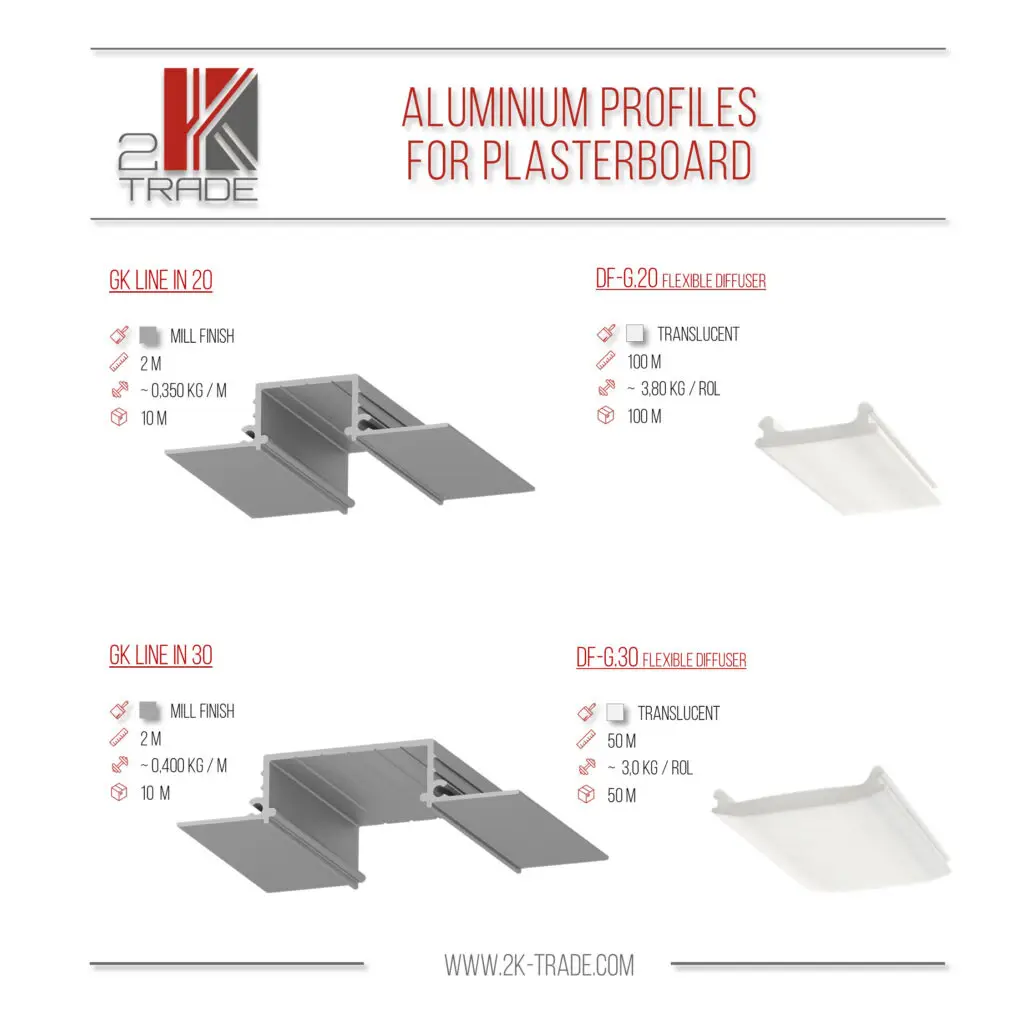
GK LINE IN 20 is a low-profile recessed LED channel for plasterboard, designed for situations where build height is at a premium. The profile is just 14.4 mm high and the light slot is 20.1 mm wide (overall width 62.7 mm), producing a clean, discreet line of light flush with the ceiling surface. Thanks to its slim depth, GK LINE IN 20 fits comfortably into shallow build-ups and tight cavities. Despite its compact dimensions, the profile is extruded from aluminium with a linear weight of around 0.35 kg/m, which gives it solid rigidity and draws heat away from the LED strip housed inside.
Use: GK LINE IN 20 takes a single LED strip (typical widths 8, 10 or 12 mm). The profile is built for continuous runs — side grooves on the body make it easy to join several sections into one uninterrupted line, which is particularly useful on longer installations. It uses the same diffuser as GAMMA 20, so a light line can continue from a stretch ceiling onto a plasterboard wall.
Ready for finishing: GK LINE IN 20 is supplied in a raw mill finish, which makes priming, filling and painting the visible flange of the profile straightforward. Bare aluminium accepts both filler and paint very well, so the profile blends into the ceiling surface. That said, the inside of the channel — where the LED strip will sit — must not be painted, and we explain why further down the article.
GK LINE IN 30 is the wider sibling in the family, developed for installations that call for a stronger, more pronounced line of light. The 34 mm channel takes two LED strips at once (10–12 mm strips side by side) or a single higher-output strip, giving you a broader, brighter band of light. As with the 20 version, the overall height of GK LINE IN 30 is just 14.4 mm (overall width 73.6 mm), while its flanges remain narrow (12.4 mm), allowing a virtually invisible installation — the body sits flush with the ceiling and only the light slot itself is visible.
Power and flexibility: with GK LINE IN 30 you have real freedom when choosing the light source. You can run two standard LED strips for higher brightness, or fit a single high-density strip when you need an intense line of light. The wide aperture spreads the light evenly across a larger surface, which works well in larger residential rooms and commercial spaces.
Solid construction: GK LINE IN 30 weighs around 0.40 kg/m, which translates into heat dissipation even when two LED strips are running at the same time. The mill-finish aluminium makes finishing work easy — the surfaces in contact with the plasterboard can be filled and painted along with the ceiling, leaving only the inside of the LED channel unpainted (more on that below). The profiles are supplied in 2-metre lengths (packed in 10 m bundles), which simplifies transport and on-site handling.

One of the most common questions on site is exactly this — should you paint an aluminium recessed LED profile in plasterboard together with the rest of the ceiling, or not? The GK LINE IN profile (like other recessed profiles) is designed so that its visible edges integrate cleanly into the ceiling surface. In practice this means the outer parts of the profile can be filled, sanded and painted — the raw aluminium provides good adhesion for both filler and paint. What you must never paint is the inside of the channel, i.e. the section that will house the LED strip and the diffuser. Painting the inside walls causes several problems: paint creates a smooth, slippery layer the LED strip cannot bond to reliably, it makes the diffuser harder to push into place, and it reduces heat transfer from the strip to the aluminium body.
So how should you handle painting? The simplest and safest method is to mask off the channel with painter’s tape or plastic film — seal the slot for the duration of the painting work so that no paint reaches the inside of the profile. The correct sequence is: first install the profile in the plasterboard, then fill and sand the joint between the profile flange and the board, and just before painting, mask the slot. Once the ceiling is finished, simply peel off the tape or film — the inside of the profile stays clean and bare, ready to take the LED strip and the diffuser. This approach gives a durable installation: the LED strip bonds firmly to the profile, and the uncoated aluminium dissipates heat from the diodes more efficiently.
The aluminium profile is only one part of the system — to actually achieve a continuous, uniform line of light you need to pair it with the right LED diffuser. For the GK LINE IN profiles we offer dedicated diffusers:

The GK LINE IN 20 and GK LINE IN 30 profiles are solutions for anyone looking for linear LED lighting in plasterboard constructions. The first model is the right choice wherever you need a narrow, subtle line of light and minimum build height. The second is for projects that call for a wider band of light or higher brightness through a double LED source. Both profiles share the same 14.4 mm height and the same installation rules.
If you are planning an LED installation in a suspended ceiling, read the full specifications on our website: LED profile “GK LINE IN 20” for plasterboard and LED profile “GK LINE IN 30” for plasterboard. If you have any questions, get in touch — a 2K-Trade manager will help you choose the right solution in your own language. You can also browse the full range of recessed aluminium profiles for plasterboard in the Special profiles for plasterboard constructions category on our website.
GK LINE IN 20 has a 20.1 mm light slot and houses a single LED strip, while GK LINE IN 30 has a 34 mm channel that fits two LED strips side by side for higher brightness. Both profiles are 14.4 mm high.
Yes, the visible outer edges of the profile can be filled and painted. The inside of the LED channel must be masked off with painter’s tape so that adhesion of the LED strip and heat dissipation are not compromised.
GK LINE IN 20 takes the flexible DF-G.20 diffuser. GK LINE IN 30 takes two options: the flexible DF-G.30 and the rigid DH-G.30, also available in a black version.
Author: MB 2K-Trade
Practical guide to stretch ceiling accessories and tools: platforms, reinforcing rings, harpoons, gaskets,

Wafer head screws: applications in stretch ceiling installation and lightweight steel construction, sizes
LED profiles for plasterboard are aluminium channels recessed into plasterboard ceilings and walls.