LED Facade Lighting: IP Ratings, Components and Installation
LED facade lighting is an outdoor lighting system based on LED strips rated IP65 or higher, mounted in weather-resistant aluminium profiles. IP65 means full protection against dust and water jets from any direction — the minimum required for building facades. IP67 strips also withstand temporary immersion, IP68 continuous immersion. A typical system consists of a 24 V DC LED strip (9.6-14.4 W/m), an aluminium profile with diffuser and seals, a power supply in an IP65 or higher enclosure and, optionally, a controller. Colour temperature for facades: 3000 K (warm, historic buildings) or 4000 K (neutral, commercial buildings). System lifetime: 30,000-50,000 hours with correct installation and heat dissipation.
LED facade lighting is one of the fastest-growing applications of LED strips and linear fixtures in commercial and residential construction. Illuminating a building facade serves an aesthetic purpose (emphasising the architecture), an informational one (identifying the building at night) and a safety one (lighting entrance areas). In this article we cover the technical requirements, IP ratings, product types and installation rules for LED lighting on facades.
Requirements for outdoor lighting — IP rating
The IP (Ingress Protection) rating is the most important parameter when choosing facade lighting. It defines the resistance of a device to dust and water. Facade installations are subject to strict requirements:
IP rating
Dust protection
Water protection
Use on a facade
IP20
None
None
NO — interiors only
IP44
Objects > 1 mm
Splashing
Only under a roof (arcades, canopies)
IP65
Dust-tight
Water jets from any direction
YES — the facade standard
IP67
Dust-tight
Temporary immersion (up to 1 m, up to 30 min)
YES — zones exposed to flooding
IP68
Dust-tight
Continuous immersion (depth per manufacturer)
Fountains, pools, underground installations
The minimum rating for facade lighting without additional cover is IP65. This applies to every component of the system: the LED strip, the profile (with seals), the power supply and the connectors. A single component with a lower IP rating compromises the whole system.
LED strips for facade lighting
For outdoor mounting, LED strips with a silicone coating (IP65) or in a silicone sleeve (IP67/IP68) are used. The coating protects the LEDs and the copper traces of the PCB from moisture, salt, UV radiation and temperatures from -20 to +60 degrees Celsius.
IP65 LED strip — the facade standard
A strip with a thin layer of silicone applied over the LEDs. It stays flexible and is resistant to rain, snow and dust. Example from the 2K-Trade range: LED strip 140 LED/m 24V SMD-2835 IP65 — 9.6 W.
Technical parameters:
Density: 140 LED/m (SMD 2835)
Power: 9.6 W/m
Voltage: 24V DC
Colour temperature: 3000 K / 4000 K / 6000 K
Protection rating: IP65
Operating temperature: -20 to +60 degrees C
IP67 and IP68 strips — extreme conditions
Strips in a full silicone sleeve (tubing) or potted in epoxy resin. Used where there is constant contact with water: gutters, roof edges, zones next to fountains, ground-level installations. The drawbacks are slightly lower brightness (the sleeve absorbs 5-10% of the light) and harder replacement.
Aluminium profiles for outdoor mounting
Mounting an LED strip on a facade without an aluminium profile is a technical error. In an outdoor installation the profile performs four functions:
Heat dissipation — aluminium conducts away the heat generated by the LEDs and extends the life of the strip. Outdoors, temperature swings (summer/winter) put additional stress on the LEDs.
Mechanical protection — the profile shields the strip from wind, hail, birds and accidental damage.
Optical protection — the diffuser in the profile removes visible LED dots and glare for passers-by.
Sealing — a profile with seals and end caps forms a closed chamber that protects the strip and the electrical connections from moisture.
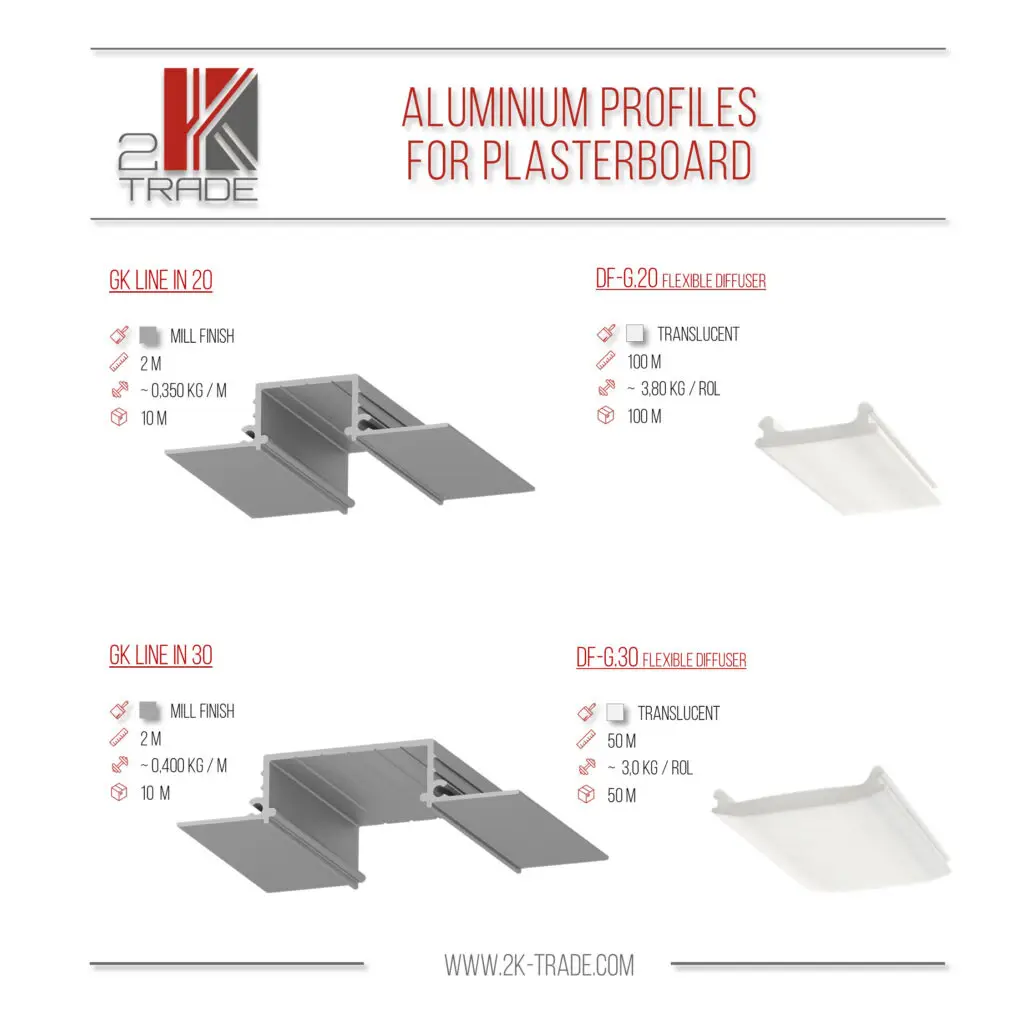
The 2K-Trade catalogue has no dedicated facade profile — the profiles for LED lighting of the GAMMA series are designed for stretch ceilings. For facade mounting use an outdoor profile with seals and end caps, and a silicone seal where the profile meets the facade.
Power supplies for outdoor installations
An LED power supply for a facade installation must meet the following requirements:
Parameter
Facade requirement
Notes
Protection rating
IP65 or higher
Power supply in a sealed metal enclosure
Output voltage
24V DC (constant)
Matching the LED strip voltage
Power
Strip power x 1.3
30% headroom for start-up and extreme temperatures
Operating temperature
-30 to +70 degrees C
Budget power supplies may not work below -10 degrees C
The power supply should be placed in an accessible location (e.g. a box on the facade, an attic, a basement) where it can be replaced easily. Cables from the power supply to the LED strip should be run in UV-resistant cable ducts. The range of power supplies is available in the LED power supplies category.
Colour temperature on a facade
The choice of colour temperature for facade lighting depends on the character of the building and its surroundings:
2700-3000 K (warm white) — historic buildings, townhouses, hotels, restaurants. Warm light emphasises natural materials (brick, stone, wood) and creates a cosy atmosphere.
4000 K (neutral white) — commercial buildings, offices, public buildings. Neutral light renders facade colours faithfully and gives good visibility.
6000 K (cool white) — rarely used on facades, unless the architectural design calls for a cool, futuristic look. Note: cool light attracts insects at night.
RGB / RGBW — colour lighting for commercial buildings, hotels, entertainment venues. The facade colour can be changed remotely (controller + remote or a DMX system).
Typical LED facade lighting scenarios
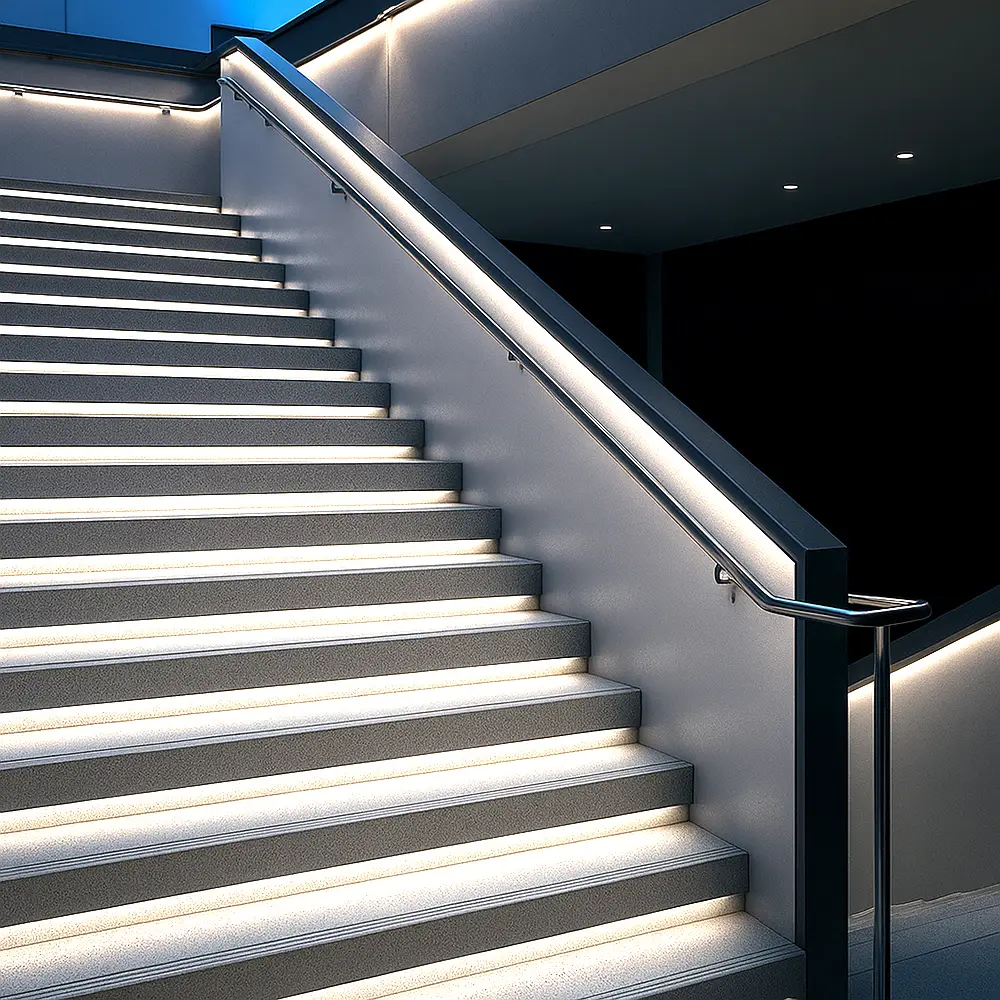
Light line on cornices and parapets
An LED strip in a profile mounted on a cornice or parapet, aimed upwards (at the facade above) or downwards (at the facade below). The most common application in commercial buildings. The profile is mounted at an angle of 15-30 degrees from vertical so that the light spreads evenly over the facade.
Framing windows and doors
An LED strip in a profile mounted around windows or entrance doors. It emphasises the window openings and creates striking frames of light. Requires precise 45-degree cutting of the profiles at the corners.
Lighting the building plinth
Mounted at ground level, with the light aimed upwards along the facade. It creates the effect of a “floating” building. IP67 is required in this zone because of rainwater and lying snow.
Full-surface facade lighting
Lines of LED strip mounted every 50-100 cm over the whole facade surface. Used in commercial buildings and entertainment venues. Requires a lot of power (e.g. a 10 x 15 m facade with lines every 50 cm = 300 m of LED strip; at 10 W/m that is 3000 W).
Installing LED lighting on a facade — key rules
Installing LED lighting on a building facade requires a few technical rules to be followed:
Connection to the 230V mains — must be made by a qualified electrician. The LED power supply converts 230V AC into safe 24V DC.
Cable routing — 230V and 24V cables run separately, in UV-resistant ducts. Minimum cross-sections for 24V cables: 1.5 mm2 up to 5 m, 2.5 mm2 up to 10 m.
Sealing — all connections, connectors and cable entries sealed with silicone or IP65 cable glands.
Water drainage — profiles mounted with a slight slope (1-2 degrees) so that water does not collect in the channel. Drain holes in the lower end caps.
Thermal expansion — a 3 m aluminium profile changes length by about 3.5 mm for a 50 K temperature difference between winter and summer. Leave an expansion gap at the joints.
Lifetime and maintenance
A correctly installed LED facade lighting system runs for 30,000-50,000 hours. At an average of 10 hours a day (dusk to dawn) that is 8-14 years. Factors that shorten the lifetime:
Overheating (no aluminium profile) — noticeably shortens LED life
Moisture in the connections — corrosion of solder pads, short circuits
UV radiation — gradual degradation of the silicone coating and yellowing of diffusers; check the coating during the annual inspection
Vibration — loosening of mechanical connectors
Maintenance is limited to an annual inspection: checking the tightness of the profiles, the condition of the diffusers (UV yellowing), the cleanliness of the connectors and the operation of the power supply.
Frequently asked questions
Will an IP65 LED strip survive a Central European winter?
Yes. IP65 LED strips are tested in the temperature range from -20 to +60 degrees Celsius. The silicone coating protects against moisture, snow and freeze/thaw cycles. Condition: correct installation in a sealed aluminium profile.
How much electricity does LED facade lighting use?
A typical facade installation (20 m of LED strip at 9.6 W/m) draws 192 W. Running 10 hours a day, that is 1.92 kWh/day, or about 57.6 kWh/month. Cost: about 17 EUR/month at an electricity price of 0.30 EUR/kWh. That is 80-90% less than traditional halogen lighting of similar brightness.
Do I need a permit for facade lighting?
The rules differ by country and municipality. As a rule, adding LED lighting to a facade does not require a building permit if it does not change the dimensions of the building. Listed (heritage) buildings require the consent of the heritage authority. In landscape protection zones local restrictions on light pollution may apply — check this before installation.
How do I control facade lighting remotely?
Three ways: (1) a radio remote — simple, range up to 30 m, on/off and dimming; (2) a WiFi/Zigbee controller — control from a phone, schedules, smart home integration; (3) a DMX system — professional, for large RGB installations with dynamic effects. Controllers are available in the categories drivers for LED strips and remote controls and wall panels for LED.
Can I install facade lighting myself?
The low-voltage part (24V LED strip, profiles, connectors) can be installed by anyone with basic technical knowledge. The connection to the 230V AC mains (power supply) should be made by a qualified electrician.
Summary
LED facade lighting requires components rated at least IP65 — strips, profiles, power supplies and connectors alike. The key to a durable installation is correct sealing, heat dissipation through aluminium profiles and a power supply with headroom. Running costs are 80-90% lower than traditional halogen lighting, and the lifetime reaches 10-14 years with correct installation.
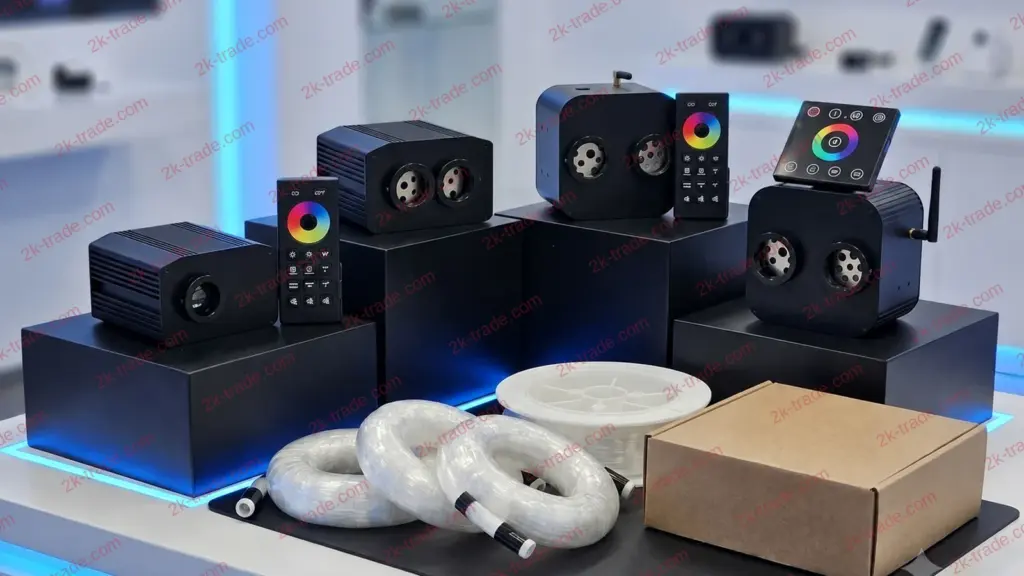
We have resumed sales of fibre optic star ceiling kits. How to choose the light engine (16, 30, 50 W), how many Ø 0.75 and Ø 1.0 mm fibres it feeds, reel or ready-made bundle, a worked example, installation and net prices.
To provide the best experiences, we use technologies like cookies to store and/or access device information. Consenting to these technologies will allow us to process data such as browsing behavior or unique identifiers on this site. Not consenting or withdrawing consent may adversely affect certain features and functions.
Functional
Always active
Przechowywanie lub dostęp do danych technicznych jest ściśle konieczny do uzasadnionego celu umożliwienia korzystania z konkretnej usługi wyraźnie żądanej przez subskrybenta lub użytkownika, lub wyłącznie w celu przeprowadzenia transmisji komunikatu przez sieć łączności elektronicznej.
Preferences
Przechowywanie lub dostęp techniczny jest niezbędny do uzasadnionego celu przechowywania preferencji, o które nie prosi subskrybent lub użytkownik.
Statistics
Przechowywanie techniczne lub dostęp, który jest używany wyłącznie do celów statystycznych.Przechowywanie techniczne lub dostęp, który jest używany wyłącznie do anonimowych celów statystycznych. Bez wezwania do sądu, dobrowolnego podporządkowania się dostawcy usług internetowych lub dodatkowych zapisów od strony trzeciej, informacje przechowywane lub pobierane wyłącznie w tym celu zwykle nie mogą być wykorzystywane do identyfikacji użytkownika.
Marketing
Przechowywanie lub dostęp techniczny jest wymagany do tworzenia profili użytkowników w celu wysyłania reklam lub śledzenia użytkownika na stronie internetowej lub na kilku stronach internetowych w podobnych celach marketingowych.