How to Choose a Stretch Ceiling Profile: Selection Guide
Profile selection guide for stretch ceilings: mounting method (wall or ceiling-mount SU profile),






06.04.2026 | LED Lighting, Profiles for Stretch Ceilings
Recessed LED profiles are aluminium mounting elements designed for concealed LED strip installation within a ceiling or wall surface. Once installed, only the diffuser with its uniform glow is visible — the entire supporting structure remains hidden. In this guide we discuss recessed profile types, their dimensions, installation rules for different substrates, and how to select compatible LED strips and diffusers.
A surface-mounted profile is fixed onto the ceiling or wall surface and remains visible as a decorative element. A recessed profile is embedded in the substrate so that its top edge sits flush with the surface. The result: a line of light emerging directly from the ceiling or wall with no visible housing.
| Feature | Surface-mounted profile | Recessed profile |
| Visibility | Aluminium housing visible | Only diffuser visible |
| Installation | Screwed or glued to the surface | Set into a slot or recess |
| Requirements | No substrate modification | Requires a slot or routing |
| Visual effect | Decorative light strip | Light line flush with the surface |
| Application | Furniture, stairs, niches | Stretch ceilings, plasterboard, walls |
The GAMMA series is a range of dedicated LED profiles designed for integration with stretch ceilings. The profile is fixed to the structural ceiling on steel angle brackets, and the membranes are tensioned on both sides of it — the harpoon locks into the grooves of the GAMMA profile. The diffuser covers the LED strip and forms the visible part of the profile in the ceiling plane. The number in the name (GAMMA 20 / 30 / 50) is the approximate width of the light line in mm, not the LED strip width — the channel is much wider than a strip, which is why GAMMA 30 takes two strips side by side. LED strips come in 8, 10 and 12 mm widths.
| Model | Light line width | Channel width | Application |
| GAMMA 20 SLIM | approx. 20 mm | approx. 17 mm | Narrow light lines, contour lighting; lower height than GAMMA 20 |
| GAMMA 30 SLIM | approx. 30 mm | approx. 31 mm | Standard light lines in ceilings; two strips side by side |
| GAMMA 30 HP | approx. 30 mm | see product card | Higher sides — better membrane tension, for higher-output strips |
| GAMMA 30 VERT | approx. 30 mm | approx. 31 mm | Vertical mount — light lines on walls |
End caps for GAMMA profiles close the profile at each end for a clean finish. Note: GAMMA 10 is a separator (membrane divider), not a lighting profile — no LED strip is planned into it.
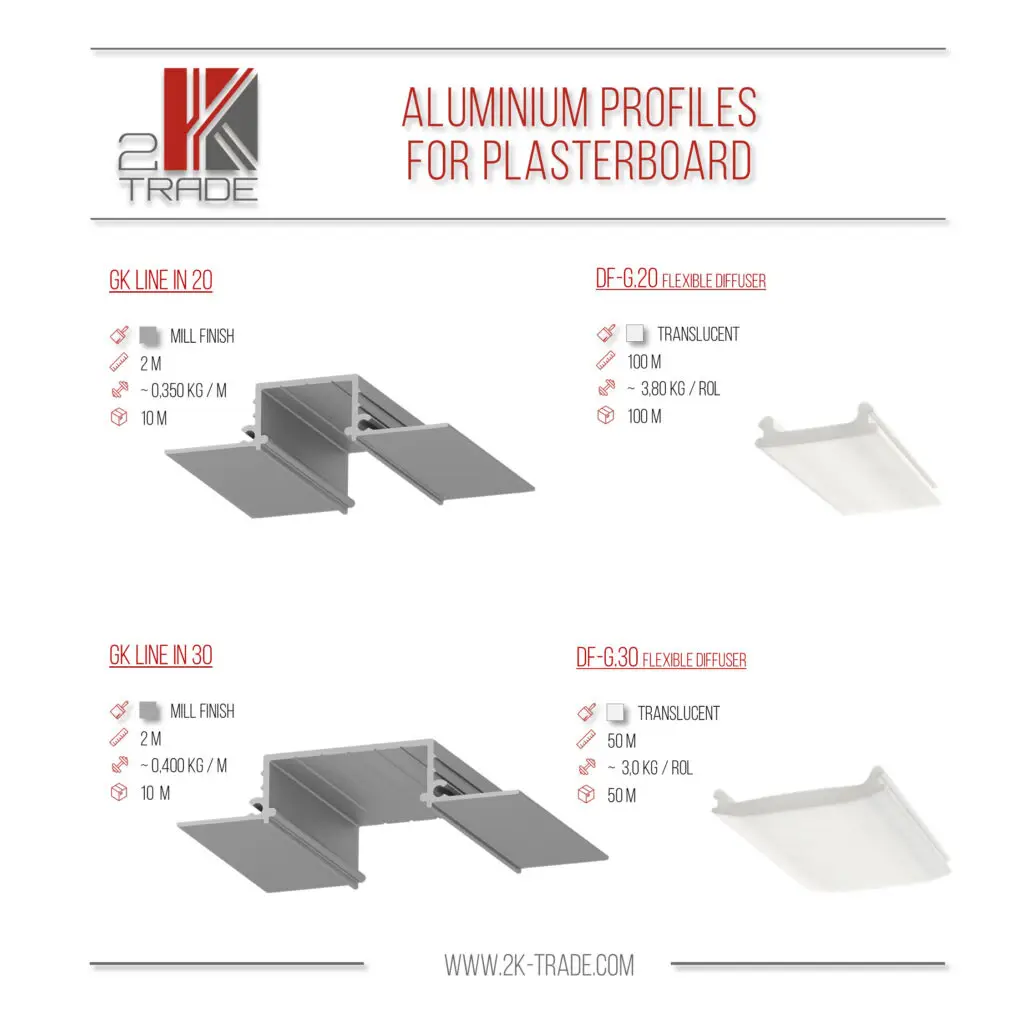
The GK LINE IN series is designed for plasterboard suspended ceilings and walls. The profile is installed in the gap between two adjacent boards. The mounting flanges (12.4 mm) rest on the board edges, and the diffuser closes the opening flush with the ceiling surface. The series has two models; the number in the name is the approximate width of the light slot. GK LINE IN 20 uses the same diffuser as GAMMA 20, so a light line can continue from a stretch ceiling onto a plasterboard wall.
| Model | Light slot | Overall width | Height | Weight |
| GK LINE IN 20 | 20.1 mm | 62.7 mm | 14.4 mm | approx. 0.350 kg/m |
| GK LINE IN 30 | 34 mm | 73.6 mm | 14.4 mm | approx. 0.400 kg/m |
GK LINE IN profiles require precise slot planning at the plasterboard installation stage. The slot must be straight and even along its whole length and sized to the profile body. The profiles are supplied in 2 m lengths, raw mill finish, packed in 10 m bundles.
Diffusers (covers) for recessed LED profiles are available in two variants:

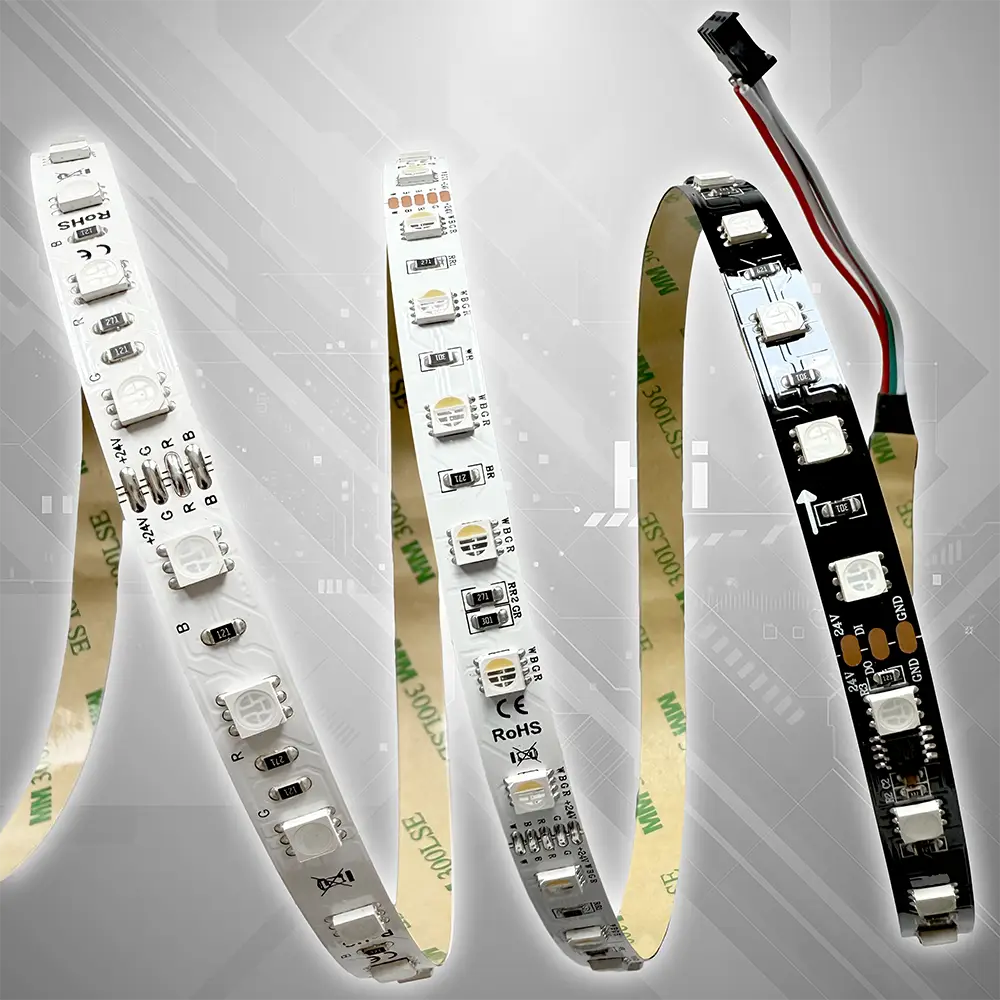
When choosing an LED strip for a recessed profile, consider the PCB width (it must fit the profile channel), wattage per metre (affects heat dissipation) and LED type (COB provides a continuous light line without dots).
| Strip type | PCB width | Power | Effect | Recommended profile |
| COB 320 LED/m | 10 mm | 10–14 W/m | Continuous dot-free line | GAMMA 20/30 SLIM |
| SMD 2835 140 LED/m | 10 mm | 9.6 W/m | Economical light line | GAMMA 20 SLIM |
| COB RGBW 784 LED/m | 12 mm | 19 W/m | Colour line with white | GAMMA 30 HP |
| Hi-Eff 192 LED/m | 10 mm | 14–20 W/m | High luminous efficacy | GAMMA 30 HP |
The aluminium profile body acts as a heat sink, drawing heat away from the LED dies. This is critical for strip longevity: the cooler the diodes run, the longer they last, and a correctly chosen profile feels at most warm to the touch. GAMMA 30 HP profiles have higher sides and more aluminium mass than GAMMA 30, which is why they are chosen for higher-output strips.
Can a GAMMA profile be used in a plasterboard ceiling? It is not recommended. GAMMA profiles are designed for mounting on brackets from the structural ceiling and for tensioning membranes — for plasterboard ceilings the GK LINE IN series is a better fit.
How do I size the power supply for an LED strip in a profile? Power supply wattage = strip length (m) x strip power (W/m) x 1.2 (20% headroom). For a 10 m run of COB 14 W/m strip you need a minimum 168 W power supply. See our LED power supply catalogue.
Does an opal diffuser significantly reduce brightness? An opal diffuser absorbs part of the luminous flux. In most interior applications the difference is imperceptible, while the gain in uniform light distribution is very noticeable.
What is the maximum run length of an LED strip without brightness drop? Standard 24 V LED strips can be fed from one end up to 5 m. For longer runs use parallel feeding — power supplied from both ends or at several points along the strip.
Can recessed LED profiles be cut to length? Yes. Aluminium profiles can be cut with a fine-toothed metal saw. Deburr the cut edge before installation.
Recessed LED profiles allow the creation of light lines flush with a ceiling or wall surface. The GAMMA series is designed for stretch ceilings, while GK LINE IN serves plasterboard suspended ceilings and walls. Correct selection of profile, diffuser and LED strip determines lighting quality and installation longevity. The full range of LED profiles and accessories is available in the 2K-Trade catalogue.
Author: MB 2K-Trade
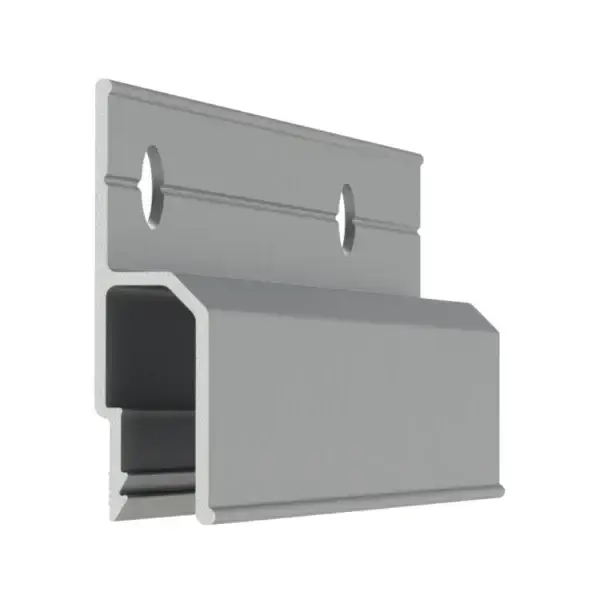
Profile selection guide for stretch ceilings: mounting method (wall or ceiling-mount SU profile),
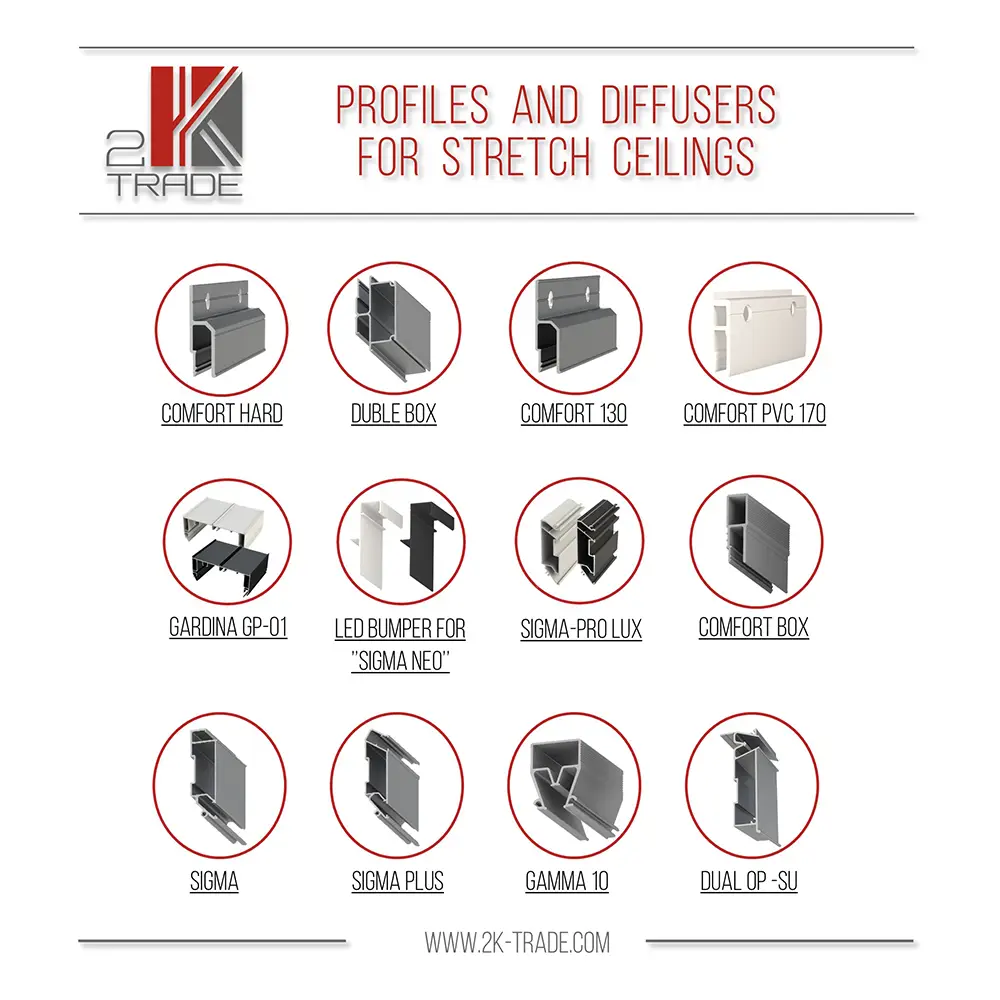
Catalogue of stretch ceiling profiles: CLASSIC and COMFORT series, ceiling-mount SU variants, shadow-gap
Comprehensive guide to stretch ceilings: membrane materials (PVC, polyester fabric), surface finishes (matte,