Recessed LED Profiles: Types, Installation and Component Selection
Guide to recessed LED profiles: types (GAMMA series for stretch ceilings, GK LINE






06.04.2026 | LED Lighting
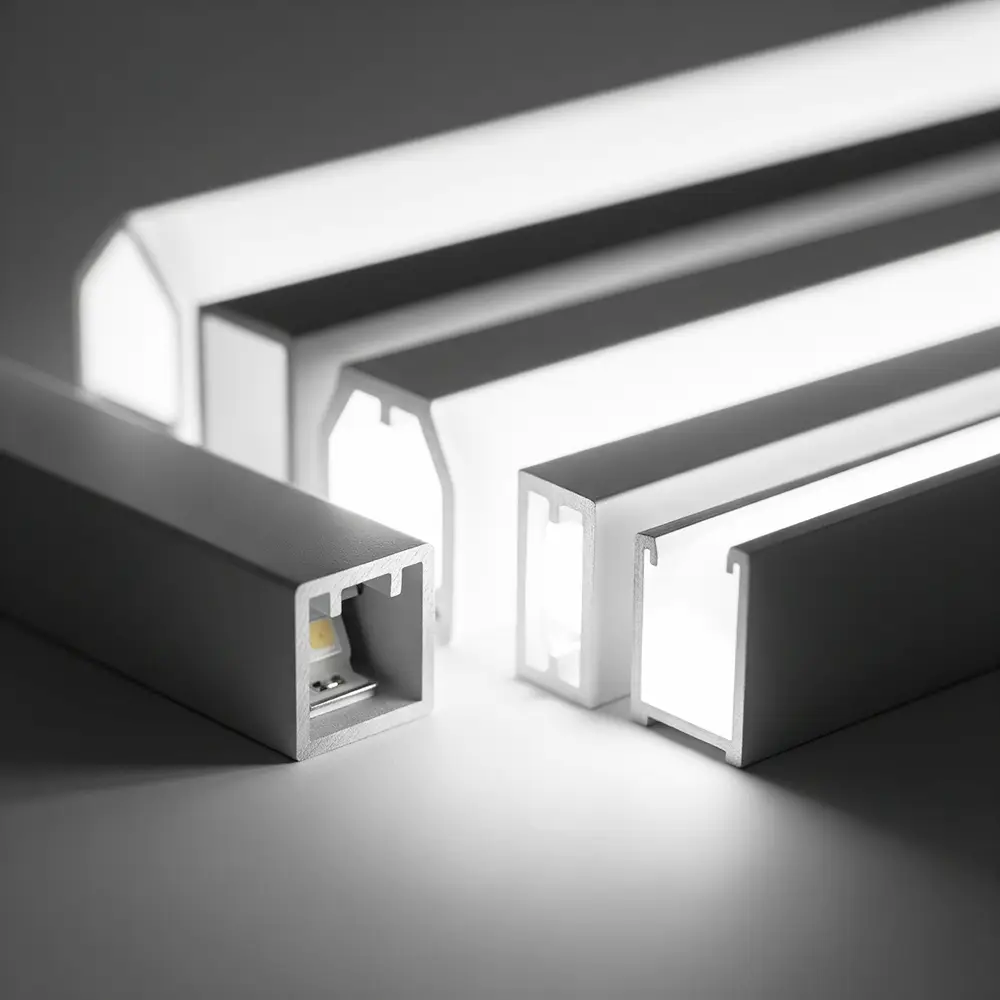
LED ceiling lighting has become the standard for residential, commercial, and hospitality interiors. Compared with conventional downlights and fluorescent panels, LED-based ceiling systems offer lower energy consumption, longer lifespan, better colour quality, and far more design flexibility. This guide covers the main ceiling lighting configurations, component selection, and practical installation advice for LED ceiling systems.
LED ceiling lighting divides into four main configurations depending on the ceiling type and desired effect:
LED strips are installed in aluminium profiles recessed into plasterboard (drywall) ceilings. The result is a flush light line level with the ceiling surface. This is the cleanest, most integrated approach and is widely used in modern residential and commercial interiors.
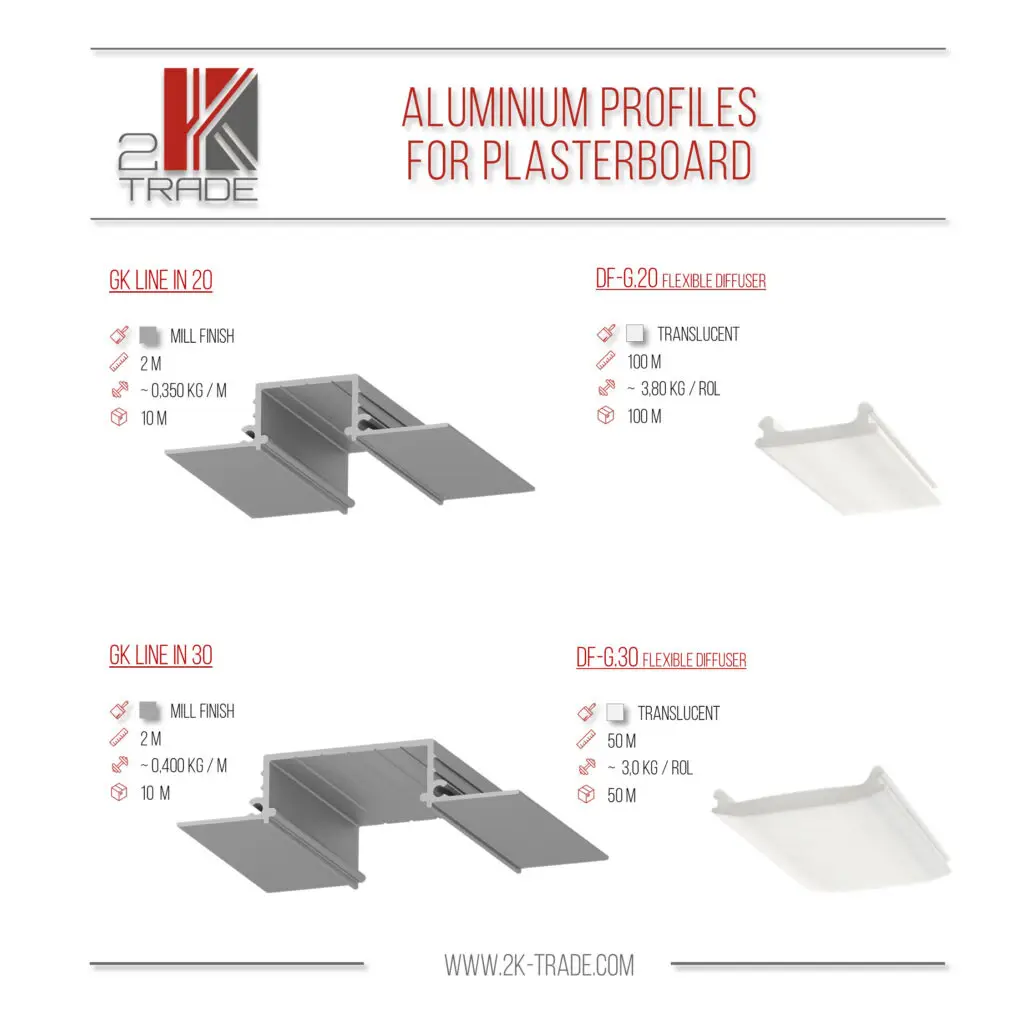
The GK LINE IN series from 2K-Trade is specifically designed for this application. Only two models exist: GK LINE IN 20 with a 20.1 mm light slot and GK LINE IN 30 with a 34 mm light slot; both are 14.4 mm high and sold in 2 m lengths. They are used for light lines in plasterboard ceilings and walls. GK LINE IN 20 takes the same diffuser as GAMMA 20, so it is also used to carry a light line from a stretch ceiling onto a plasterboard wall.
Stretch ceilings offer two LED lighting methods:
Where recessing is not possible (concrete ceilings, exposed structures, renovations), surface-mounted aluminium profiles are fixed directly to the ceiling. The profile sits proud of the surface. This approach is fast to install and works well in industrial, loft, and utility spaces.
Pendant-style LED profiles hang from cables or rods below the ceiling. They provide both downward task lighting and upward ambient light (depending on diffuser configuration). Standard in offices, meeting rooms, retail, and hospitality.
| Application | Strip type | Power (W/m) | Colour temp | Notes |
|---|---|---|---|---|
| Ambient/mood | SMD 2835 ECO, 120 LED/m | 4.8 / 9.6 | 3000 / 4000 / 6000 K | Low power, decorative |
| General illumination | SMD 2835, 140 LED/m and Hi-Eff 192 LED/m | 4.8–14.4 and 14 / 20 | 3000 / 4000 / 6000 K | Main room lighting |
| Premium dot-free | COB 320 LED/m | 10 / 14 | 3000 / 4000 / 6000 K | Continuous light line |
| Tuneable white | CCT 120 LED/m | 9.6 | 2700–6000 K | Adjustable warm-to-cool |
| Decorative colour + white | COB RGBW 784 LED/m | 19 | RGB + white 4000 or 6000 K | Accent and mood effects |
All ceiling LED strips should operate at 24 V DC for efficiency and safety. IP20 is sufficient for dry interiors; for bathrooms choose IP65. Browse the full LED strip range at 2K-Trade.
An aluminium profile is essential for any ceiling LED installation. It dissipates heat (extending strip life), protects the strip, and houses the diffuser for even, dot-free light. Profile choice depends on ceiling type:
A note on naming: two naming systems coexist in the 2K-Trade catalogue. In the CLASSIC and COMFORT mounting profiles the number is the approximate mass of one running metre in grams (e.g. CLASSIC 125 ≈ 125 g/m). In the GAMMA and GK LINE IN lighting profiles the number is the approximate width of the light line or slot in millimetres. The number says nothing about how far the ceiling drops below the slab — that is set by the mounting type of the profile and by the installation itself.
The GAMMA series combines the function of a stretch ceiling mounting profile with an LED channel. The harpoon of the membrane hooks into the profile, and the LED strip is mounted in the dedicated channel. The channel is much wider than the strip itself: LED strips are 8, 10 or 12 mm wide, while the number in the profile name (20, 30, 50) is the approximate width of the visible light line. All profiles are sold in 2 m lengths.
| Model | Light line | LED strips in the channel | Application |
|---|---|---|---|
| GAMMA 20 | approx. 20 mm | 1 strip 8–12 mm | Standard light line, SMD and COB strips |
| GAMMA 20F | approx. 20 mm | 1 strip 8–12 mm (channel approx. 17 mm) | Reinforced version (thicker walls) with mounting flange, for long runs |
| GAMMA 20 SLIM | approx. 20 mm | 1 strip 8–12 mm (channel approx. 17 mm) | Lower version (approx. 31 mm high) for limited space above the ceiling |
| GAMMA 30 | approx. 30 mm | up to 2 strips side by side (channel approx. 31 mm) | Wider line between two membranes, COB and RGBW strips |
| GAMMA 30 SLIM | approx. 30 mm | up to 2 strips side by side (channel approx. 31 mm) | Lower version of GAMMA 30 (approx. 31 mm high) |
| GAMMA 30 HP | approx. 30 mm | up to 2 strips side by side | Higher sides: better membrane tension, installation with a double harpoon |
| GAMMA 30.VERT | approx. 30 mm | up to 2 strips side by side (channel approx. 31 mm) | Vertical mounting (light line on a wall) |
| GAMMA 50 | approx. 50 mm | up to 3 strips of 12 mm (channel approx. 45.6 mm) | Wide light line, large spaces |
GAMMA 10 is a separator — the narrowest profile of the series, used to divide two ceiling membranes (e.g. two colours or zones). It is not a lighting profile and no LED strip is mounted in it.
The SIGMA-NEO LED profile is a niche profile with an LED strip channel, intended for stretch ceilings. It is fixed to the ceiling on steel brackets; length 2 m, approx. 730 g/m, unpainted finish.
The EN 12464-1 standard sets required illuminance for workplaces (offices, professional kitchens, corridors in public buildings). For residential rooms — bedrooms, living rooms, domestic kitchens — there are no normative requirements; the values below are indicative and come from design practice. Illuminance (lux) is converted into the luminous flux (lumens) the LED strips must deliver.
| Room | Indicative illuminance (lx) | Lumens/m² | Example: 20 m² room |
|---|---|---|---|
| Bedroom | 100–150 | 100–200 | 2,000–4,000 lm |
| Living room | 150–300 | 150–350 | 3,000–7,000 lm |
| Kitchen (general) | 300 | 300–400 | 6,000–8,000 lm |
| Office | 500 | 500–600 | 10,000–12,000 lm |
| Corridor | 100 | 100–150 | 2,000–3,000 lm |
| Bathroom | 200–300 | 200–350 | 4,000–7,000 lm |
With indirect lighting (light reflected off the ceiling) the reflection losses are 30–40%. This means the strip has to emit 1.4–1.7 times more lumens than the required illuminance. For example: a 20 m² living room needs 5,000 lm, but allowing for reflection losses — 7,000–8,500 lm from the LED strips.
Size the power supply at 120% of total strip power consumption. For a room with 12 m of strip at 14.4 W/m: 12 × 14.4 × 1.2 = 207 W minimum PSU. A 240 W unit provides comfortable headroom.
Place the power supply in an accessible location (ceiling void, cupboard, or dedicated enclosure) with adequate ventilation. For runs over 5 m, use centre-feed or dual-end feed wiring to minimise voltage drop. Browse LED power supplies at 2K-Trade.
When combining LED lighting with a stretch ceiling, the drop of the membrane below the structural ceiling is determined by the mounting type of the perimeter profile (SU profiles fixed to the ceiling, standard profiles fixed to the wall) and by the installation — not by the number in the profile name. With a wall-mounted profile the loss of room height is a few centimetres (the profile height of about 3 cm plus the installer’s margin). Full-surface backlighting needs more depth for the LED modules, which is planned per project. Full stretch ceiling profile catalogue at 2K-Trade.
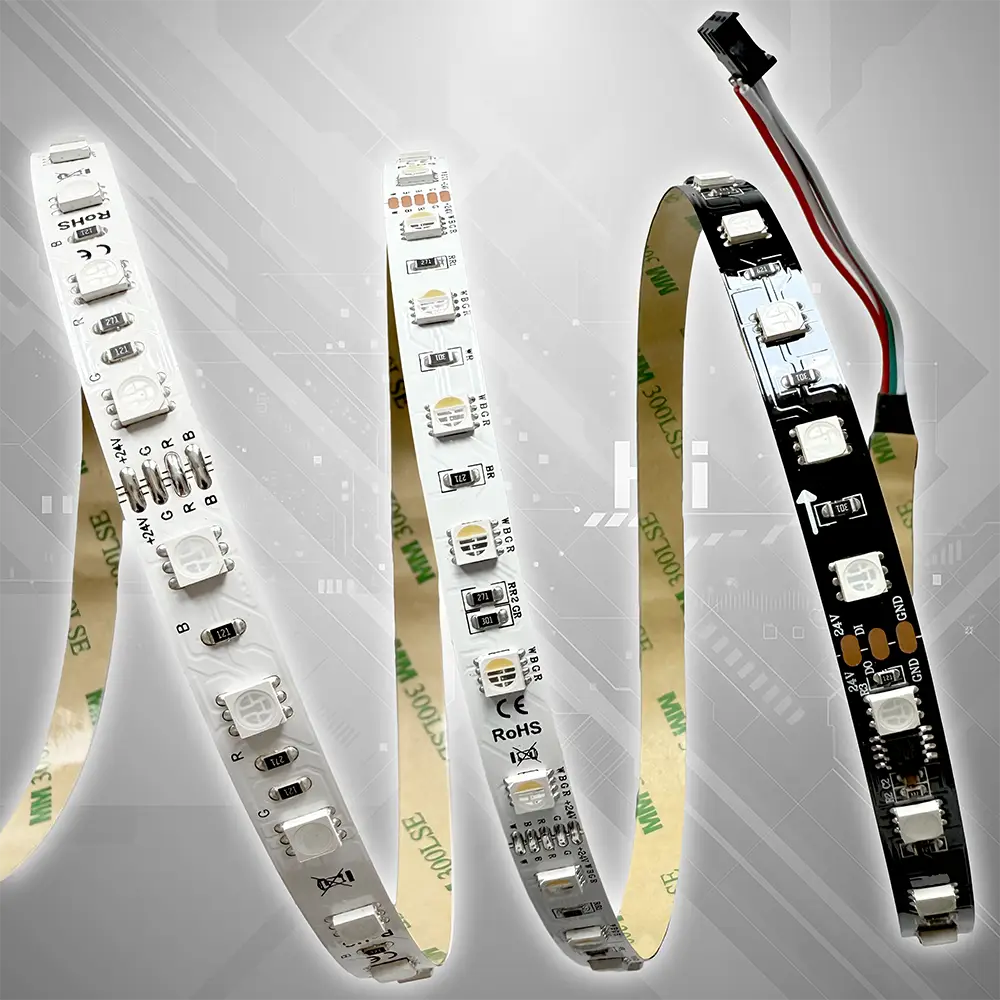
Yes, provided the strip power and density are chosen accordingly. For general lighting use higher-output strips, e.g. Hi-Eff 192 LED/m (14 or 20 W/m). Around the perimeter of a 4 × 4 m room (16 m) this gives up to 320 W of installed power — enough for the main lighting of a residential room. For task-intensive areas (kitchens, offices), supplement with focused downlights or pendant lights.
2700–3000 K (warm white) is standard for residential living spaces, bedrooms, and hospitality. 4000 K (neutral white) is preferred for offices, kitchens, bathrooms, and retail. CCT tuneable strips (2700–6000 K) allow you to switch between warm and cool throughout the day.
A material set for a 20 m² room (18 m perimeter, indirect perimeter lighting) consists of: LED strip 14 W/m × 18 m, aluminium profile 18 m, a 300 W power supply, diffusers and end caps. The exact figure depends on the strip and profile model chosen; current prices are on the product cards. For a quotation for a specific project contact the 2K-Trade sales team.
Yes, all LED strips are inherently dimmable via PWM (pulse-width modulation) controllers. You need a compatible dimmer controller — either wall-mounted, remote-controlled, or smart-home integrated (Wi-Fi, Zigbee 3.0, RF). The power supply does not need to be a special “dimmable” type when using an external PWM controller. Controllers and remotes are in the remote controls and wall panels category.
An LED strip in an aluminium profile passes its heat to the profile, which acts as a heatsink, so it runs much cooler than a strip stuck directly onto a membrane or board. With the strip powers recommended for ceiling lighting an aluminium profile is a safe solution for stretch ceiling membranes, wood and plasterboard. A strip without a profile should not be mounted directly under the membrane.
Always use an aluminium profile with a frosted (opal) diffuser. For the best result, choose COB LED strips — they produce a completely continuous light line with zero visible dots. If using SMD strips, ensure the diffuser is positioned at least 10–15 mm from the LED surface for adequate diffusion.
Author: MB 2K-Trade
Guide to recessed LED profiles: types (GAMMA series for stretch ceilings, GK LINE

LED aquarium lighting is mounted above the water: an IP20 strip in a
LED facade lighting is an outdoor lighting system based on LED strips rated