Recessed LED Profiles: Types, Installation and Component Selection
Guide to recessed LED profiles: types (GAMMA series for stretch ceilings, GK LINE





06.04.2026 | LED Lighting
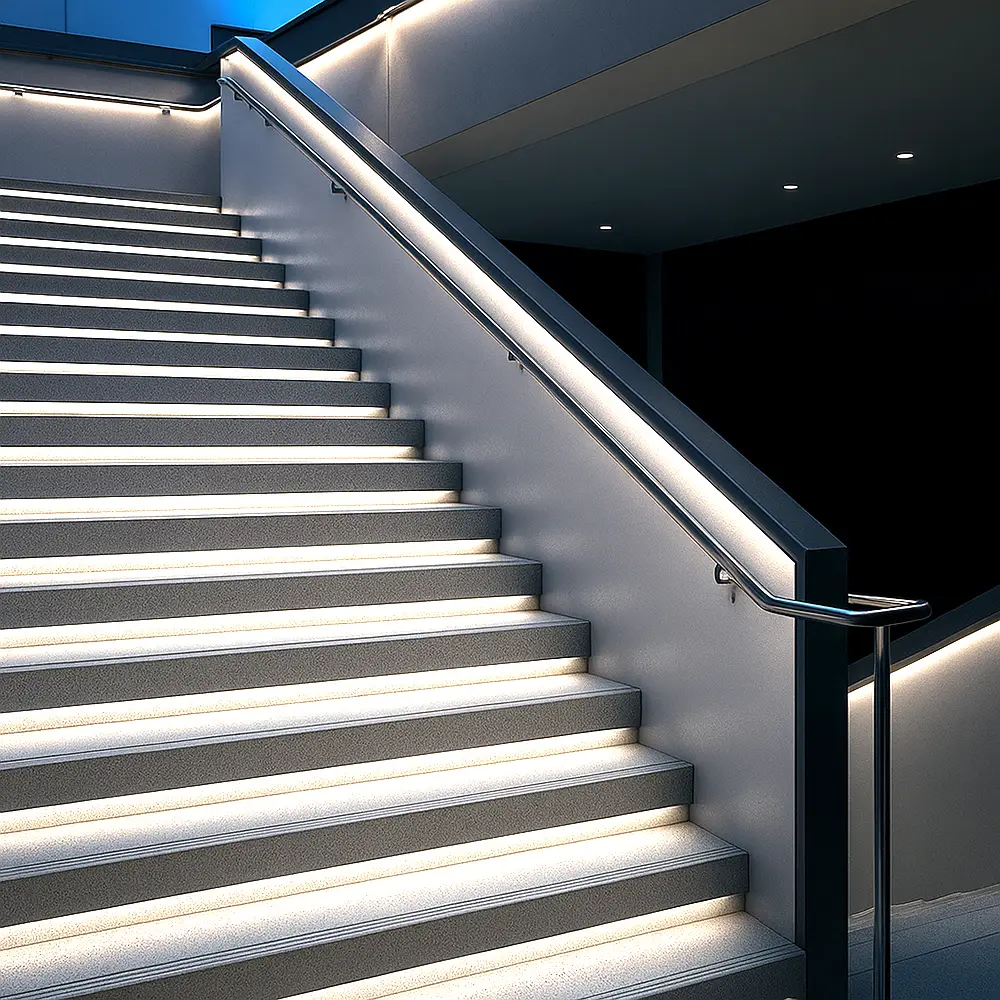
LED facade lighting is one of the fastest-growing applications of LED strips and linear fixtures in commercial and residential construction. Illuminating a building facade serves an aesthetic purpose (emphasising the architecture), an informational one (identifying the building at night) and a safety one (lighting entrance areas). In this article we cover the technical requirements, IP ratings, product types and installation rules for LED lighting on facades.
The IP (Ingress Protection) rating is the most important parameter when choosing facade lighting. It defines the resistance of a device to dust and water. Facade installations are subject to strict requirements:
| IP rating | Dust protection | Water protection | Use on a facade |
|---|---|---|---|
| IP20 | None | None | NO — interiors only |
| IP44 | Objects > 1 mm | Splashing | Only under a roof (arcades, canopies) |
| IP65 | Dust-tight | Water jets from any direction | YES — the facade standard |
| IP67 | Dust-tight | Temporary immersion (up to 1 m, up to 30 min) | YES — zones exposed to flooding |
| IP68 | Dust-tight | Continuous immersion (depth per manufacturer) | Fountains, pools, underground installations |
The minimum rating for facade lighting without additional cover is IP65. This applies to every component of the system: the LED strip, the profile (with seals), the power supply and the connectors. A single component with a lower IP rating compromises the whole system.

For outdoor mounting, LED strips with a silicone coating (IP65) or in a silicone sleeve (IP67/IP68) are used. The coating protects the LEDs and the copper traces of the PCB from moisture, salt, UV radiation and temperatures from -20 to +60 degrees Celsius.
A strip with a thin layer of silicone applied over the LEDs. It stays flexible and is resistant to rain, snow and dust. Example from the 2K-Trade range: LED strip 140 LED/m 24V SMD-2835 IP65 — 9.6 W.
Technical parameters:
Strips in a full silicone sleeve (tubing) or potted in epoxy resin. Used where there is constant contact with water: gutters, roof edges, zones next to fountains, ground-level installations. The drawbacks are slightly lower brightness (the sleeve absorbs 5-10% of the light) and harder replacement.
Mounting an LED strip on a facade without an aluminium profile is a technical error. In an outdoor installation the profile performs four functions:
The 2K-Trade catalogue has no dedicated facade profile — the profiles for LED lighting of the GAMMA series are designed for stretch ceilings. For facade mounting use an outdoor profile with seals and end caps, and a silicone seal where the profile meets the facade.
An LED power supply for a facade installation must meet the following requirements:
| Parameter | Facade requirement | Notes |
|---|---|---|
| Protection rating | IP65 or higher | Power supply in a sealed metal enclosure |
| Output voltage | 24V DC (constant) | Matching the LED strip voltage |
| Power | Strip power x 1.3 | 30% headroom for start-up and extreme temperatures |
| Operating temperature | -30 to +70 degrees C | Budget power supplies may not work below -10 degrees C |
The power supply should be placed in an accessible location (e.g. a box on the facade, an attic, a basement) where it can be replaced easily. Cables from the power supply to the LED strip should be run in UV-resistant cable ducts. The range of power supplies is available in the LED power supplies category.
The choice of colour temperature for facade lighting depends on the character of the building and its surroundings:

An LED strip in a profile mounted on a cornice or parapet, aimed upwards (at the facade above) or downwards (at the facade below). The most common application in commercial buildings. The profile is mounted at an angle of 15-30 degrees from vertical so that the light spreads evenly over the facade.
An LED strip in a profile mounted around windows or entrance doors. It emphasises the window openings and creates striking frames of light. Requires precise 45-degree cutting of the profiles at the corners.
Mounted at ground level, with the light aimed upwards along the facade. It creates the effect of a “floating” building. IP67 is required in this zone because of rainwater and lying snow.
Lines of LED strip mounted every 50-100 cm over the whole facade surface. Used in commercial buildings and entertainment venues. Requires a lot of power (e.g. a 10 x 15 m facade with lines every 50 cm = 300 m of LED strip; at 10 W/m that is 3000 W).
Installing LED lighting on a building facade requires a few technical rules to be followed:
A correctly installed LED facade lighting system runs for 30,000-50,000 hours. At an average of 10 hours a day (dusk to dawn) that is 8-14 years. Factors that shorten the lifetime:
Maintenance is limited to an annual inspection: checking the tightness of the profiles, the condition of the diffusers (UV yellowing), the cleanliness of the connectors and the operation of the power supply.
Yes. IP65 LED strips are tested in the temperature range from -20 to +60 degrees Celsius. The silicone coating protects against moisture, snow and freeze/thaw cycles. Condition: correct installation in a sealed aluminium profile.
A typical facade installation (20 m of LED strip at 9.6 W/m) draws 192 W. Running 10 hours a day, that is 1.92 kWh/day, or about 57.6 kWh/month. Cost: about 17 EUR/month at an electricity price of 0.30 EUR/kWh. That is 80-90% less than traditional halogen lighting of similar brightness.
The rules differ by country and municipality. As a rule, adding LED lighting to a facade does not require a building permit if it does not change the dimensions of the building. Listed (heritage) buildings require the consent of the heritage authority. In landscape protection zones local restrictions on light pollution may apply — check this before installation.
Three ways: (1) a radio remote — simple, range up to 30 m, on/off and dimming; (2) a WiFi/Zigbee controller — control from a phone, schedules, smart home integration; (3) a DMX system — professional, for large RGB installations with dynamic effects. Controllers are available in the categories drivers for LED strips and remote controls and wall panels for LED.
The low-voltage part (24V LED strip, profiles, connectors) can be installed by anyone with basic technical knowledge. The connection to the 230V AC mains (power supply) should be made by a qualified electrician.
LED facade lighting requires components rated at least IP65 — strips, profiles, power supplies and connectors alike. The key to a durable installation is correct sealing, heat dissipation through aluminium profiles and a power supply with headroom. Running costs are 80-90% lower than traditional halogen lighting, and the lifetime reaches 10-14 years with correct installation.
Products for facade lighting can be found in the categories: IP65 LED strips, LED power supplies, drivers for LED strips. For facade projects that need individual component selection — contact the 2K-Trade technical department.
Author: MB 2K-Trade
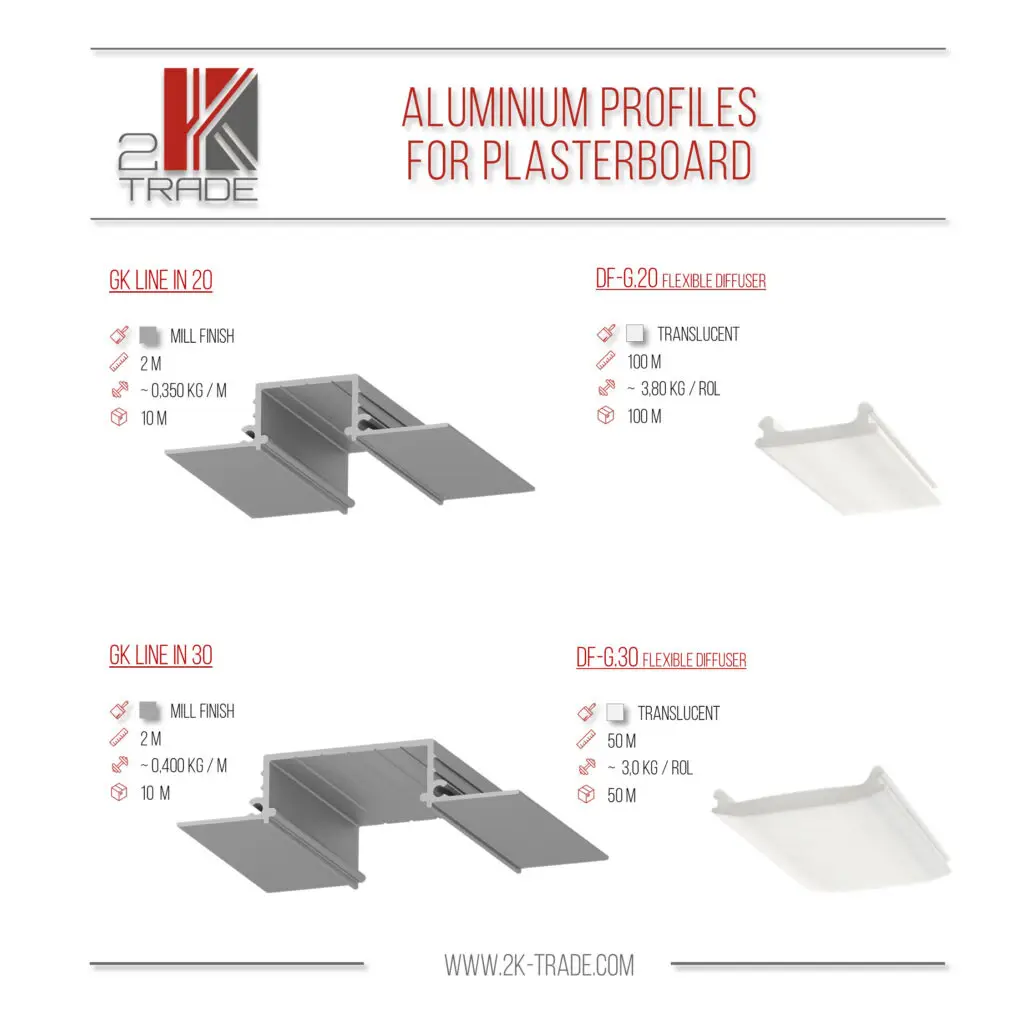
Guide to recessed LED profiles: types (GAMMA series for stretch ceilings, GK LINE

LED aquarium lighting is mounted above the water: an IP20 strip in a
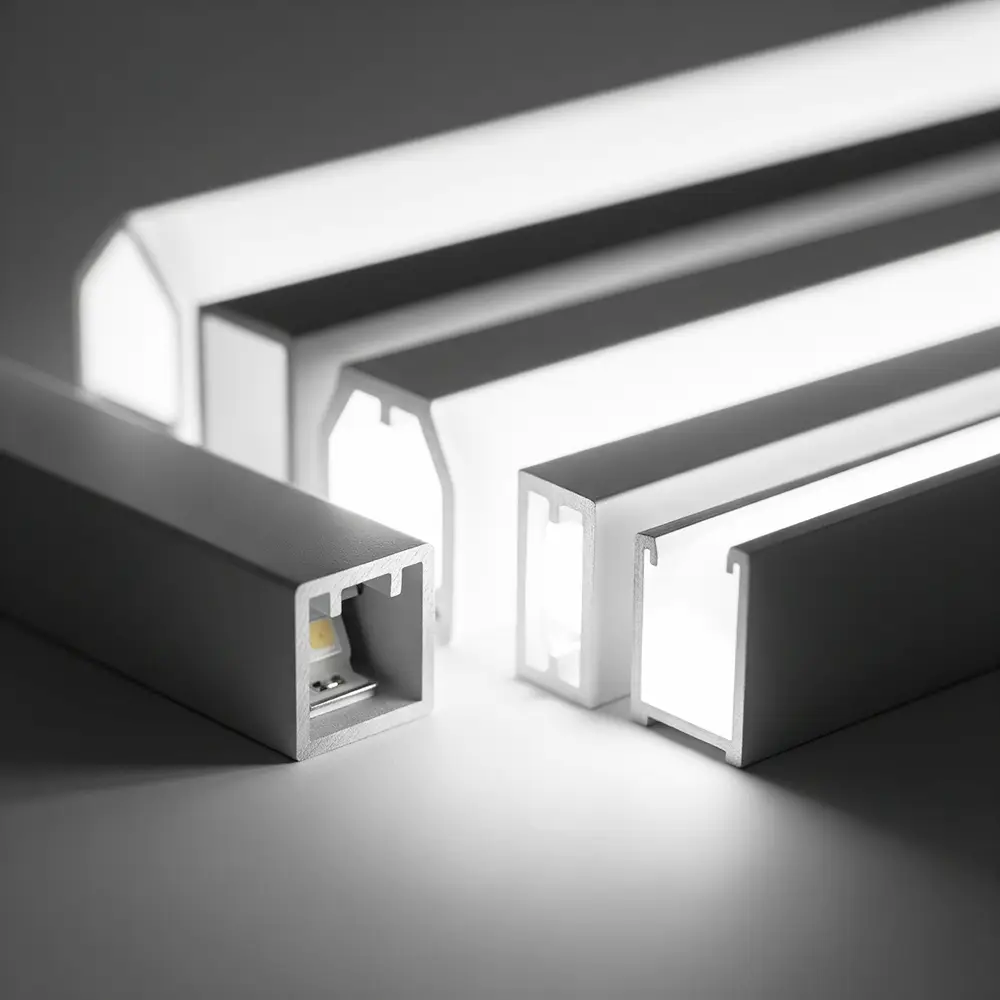
LED ceiling lighting refers to systems using LED strips, modules, or panels installed