Recessed LED Profiles: Types, Installation and Component Selection
Guide to recessed LED profiles: types (GAMMA series for stretch ceilings, GK LINE






06.04.2026 | LED Lighting

A 10 m LED strip is the standard reel length used in lighting installations — decorative and functional alike. In this article we cover the types of LED strip available on 10-metre reels, their technical parameters, the rules for cutting and joining, and the criteria for choosing a strip for a specific application.
The 10 m reel is the industry production standard for 24V LED strips. The length follows from the electrical parameters — with a single-end feed the voltage drop over 10 m is already clearly visible (10-20% brightness loss at the far end of a 24V strip), which is why a 10 m reel is fed from both ends. For 12V strips the maximum length without noticeable brightness loss is 5 m.
10-metre reels are more economical per linear metre than shorter lengths. For B2B purchases strips are also available on 20 m and 50 m reels (to order), but 10 m is the most universal format — enough for most rooms and easy to transport.
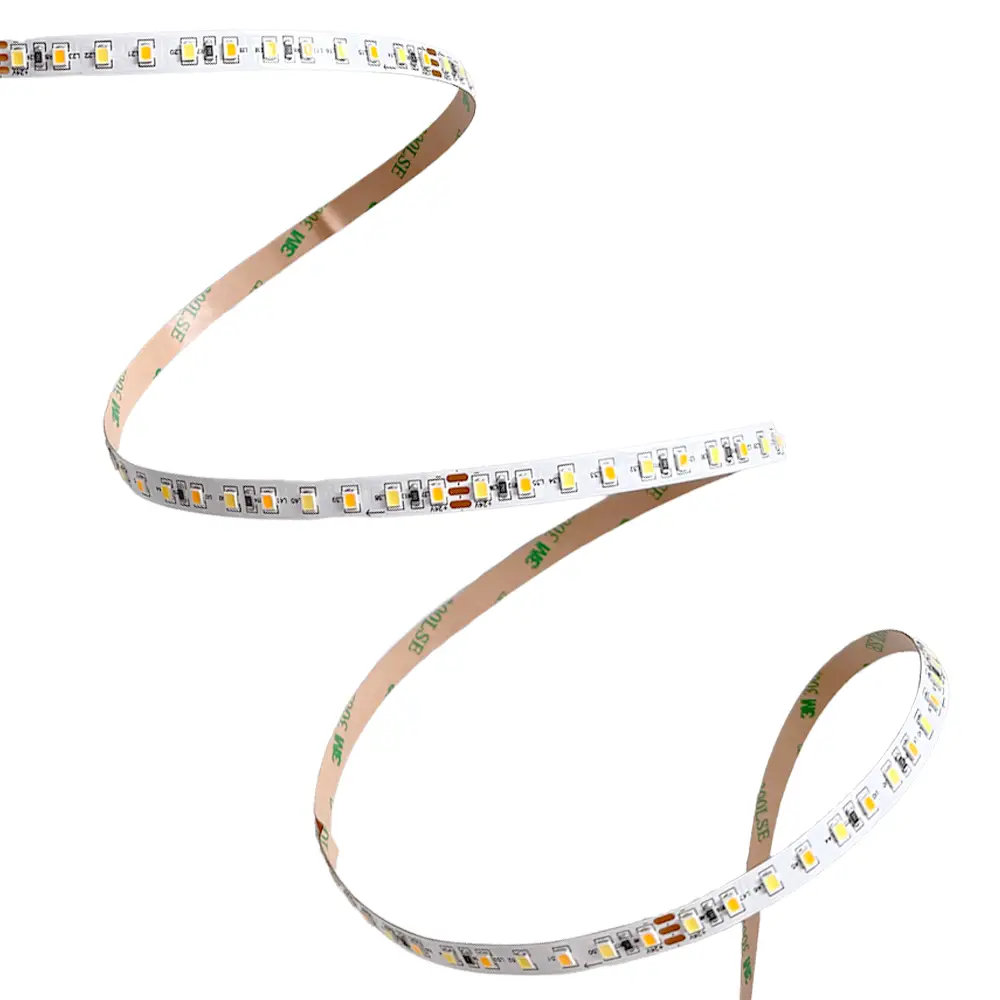
LED strips differ in LED type, density, power and functionality. Below is an overview of the types available in the 2K-Trade range.
| Strip type | Density LED/m | Power (W/m) | Light colour | Application |
|---|---|---|---|---|
| SMD 2835 ECO 120 LED/m | 120 | 4.8-9.6 | Mono (3000K/4000K/6000K) | Subtle backlighting, low budget |
| SMD 2835 140 LED/m | 140 | 4.8-14.4 | Mono (3000K/4000K/6000K) | Standard linear lighting |
| SMD 2835 Hi-Eff 192 LED/m | 192 | 14.0-20.0 | Mono (3000K/4000K/6000K) | Main lighting, public spaces |
| COB 320 LED/m | 320 | 10.0-14.0 | Mono (3000K/4000K/6000K) | Even line of light without dots |
| COB CCT 608 LED/m | 608 | 16.0 | CCT (2700-6000K adjustable) | Tuneable colour temperature, smart home |
| RGB 60 LED/m | 60 | 14.4 | RGB (colour) | Decorative lighting, colour effects |
| RGBW COB 784 LED/m | 784 | 19.0-21.0 | RGBW (colours + white) | Decoration + functional lighting |
| Digital WS2811 60 LED/m | 60 | 14.4 | RGB (addressable) | Dynamic effects, animations, pixel art |
When choosing a 10 m LED strip, four parameters are key: supply voltage, power per metre, LED density and IP rating.
24V DC strips are the professional standard. Compared with 12V strips they draw half the current at the same power, which means lower losses in the cables and longer runs without brightness loss. All strips in the 2K-Trade range operate at 24V DC.
The power of an LED strip is given in watts per metre (W/m). For a 10 m reel the total power is the power per metre multiplied by 10. For example, a 14.4 W/m strip on a 10 m reel draws 144 W in total — the power supply must be rated at least 144 W + 20% headroom (173 W). In practice a 200 W power supply is chosen.
| Strip power (W/m) | 10 m reel power (W) | Minimum power supply (W) | Approximate brightness (lm/m) |
|---|---|---|---|
| 4.8 | 48 | 60 | 350-500 |
| 9.6 | 96 | 120 | 800-1000 |
| 14.4 | 144 | 200 | 1200-1500 |
| 20.0 | 200 | 250 | 1800-2200 |

Density is measured as the number of LEDs per metre (LED/m). Higher density gives a more even line of light, but also higher power and price. Strips below 120 LED/m may show visible “dots” of light — especially with a clear diffuser. COB strips (320+ LED/m) give a perfectly even line with no visible points.
For indoor installations (living rooms, offices, corridors) IP20 strips — without an additional protective coating — are sufficient. For bathrooms, kitchens, terraces and the outside of a building, IP65 (silicone coating) or higher is required. IP67/IP68 strips are used in installations submerged in water (pools, fountains, aquariums).
LED strips may only be cut at the marked cut points — copper lines on the PCB (usually marked with a scissors symbol). The spacing of the cut points depends on the strip type:
Cutting outside a marked point damages the circuit and disables the section. Use sharp scissors or a craft knife.
After cutting the strip to length, sections are joined in one of two ways:
Plastic clips with metal contacts that press onto the pads of the strip PCB. No soldering needed. Available as straight (strip-to-strip), corner (90 degrees) and strip-to-wire versions. Drawback: they can loosen under vibration and have slightly higher contact resistance than a soldered joint.
A more durable and reliable connection. Requires a 25-40 W soldering iron with a fine tip, flux-cored solder (0.5-0.8 mm) and a little experience. Soldering time on a single pad should not exceed 2-3 seconds — longer heating damages the LEDs and the PCB laminate.
Powering a 10 m LED strip requires the right power supply and the right wiring layout. Below are the three basic layouts:
The power supply is connected at one end of the strip. Current flows in one direction. Suitable only for runs up to 5 m — beyond that there is a visible brightness drop at the far end of the strip (10-20% for 24V strips).
The power supply is connected at both ends of the 10 m strip. Current flows from both ends towards the centre, eliminating the brightness drop. Requires running the feed cable to both ends — often done as a cable loop behind the profile or ceiling.
Each 5 m section is fed independently from one power supply through a splitter. The best solution for long installations (20 m, 30 m and more). It eliminates voltage drop and allows individual sections to be replaced without dismantling the whole installation.
Single-colour (mono) strips are available in three colour temperatures:
CCT (Correlated Colour Temperature) strips allow the colour temperature to be adjusted between 2700 and 6000 K with a controller. This is the most flexible solution — one light source adapts to the time of day and the mood.
The full range of LED strips is available in the LED strips category. Selected models on 10 m reels:
To run LED strips you also need LED power supplies of adequate power and drivers for LED strips (for RGB, RGBW, CCT and digital strips). Feed cables can be found in the power cables category.
An LED strip can only be cut at the marked cut points (copper lines on the PCB, usually every 25-100 mm). Cutting anywhere else damages the circuit and disables the section between the cut and the next cut point.
Power supply rating = (strip power per metre x 10 m) x 1.2. For example, for a 14.4 W/m strip: 14.4 x 10 x 1.2 = 172.8 W. A 200 W power supply is chosen. The power supply voltage must match the strip voltage (24V DC).
With a single-end feed — no. At the far end of a 10 m reel the brightness drop can be 10-20%. For even brightness use a dual-end feed (from both ends) or a parallel feed (each 5 m fed separately).
Consumption depends on the strip power. A 9.6 W/m strip on a 10 m reel draws 96 W. Running 8 hours a day, that is 0.77 kWh/day, or about 23 kWh/month. At an electricity price of 0.30 EUR/kWh the monthly cost is about 6.90 EUR.
Yes. Single-colour strips are dimmed with a PWM dimmer (pulse-width modulation). RGB and RGBW strips need an RGB/RGBW controller with a dimming function. CCT strips are dimmed with a two-channel CCT controller. All these devices are available in the drivers for LED strips category.
The 10 m LED strip is a universal format for most lighting installations — from subtle decorative backlighting to the main lighting of commercial spaces. Key points when choosing: power per metre (W/m) determines brightness, LED density (LED/m) affects the evenness of the light, and the IP rating defines resistance to moisture. For runs over 5 m a dual-end or parallel feed is mandatory.
The full range of LED strips, power supplies and accessories is available in the LED strips catalogue. Need help choosing a strip for your project? Contact the 2K-Trade technical department.
Author: MB 2K-Trade
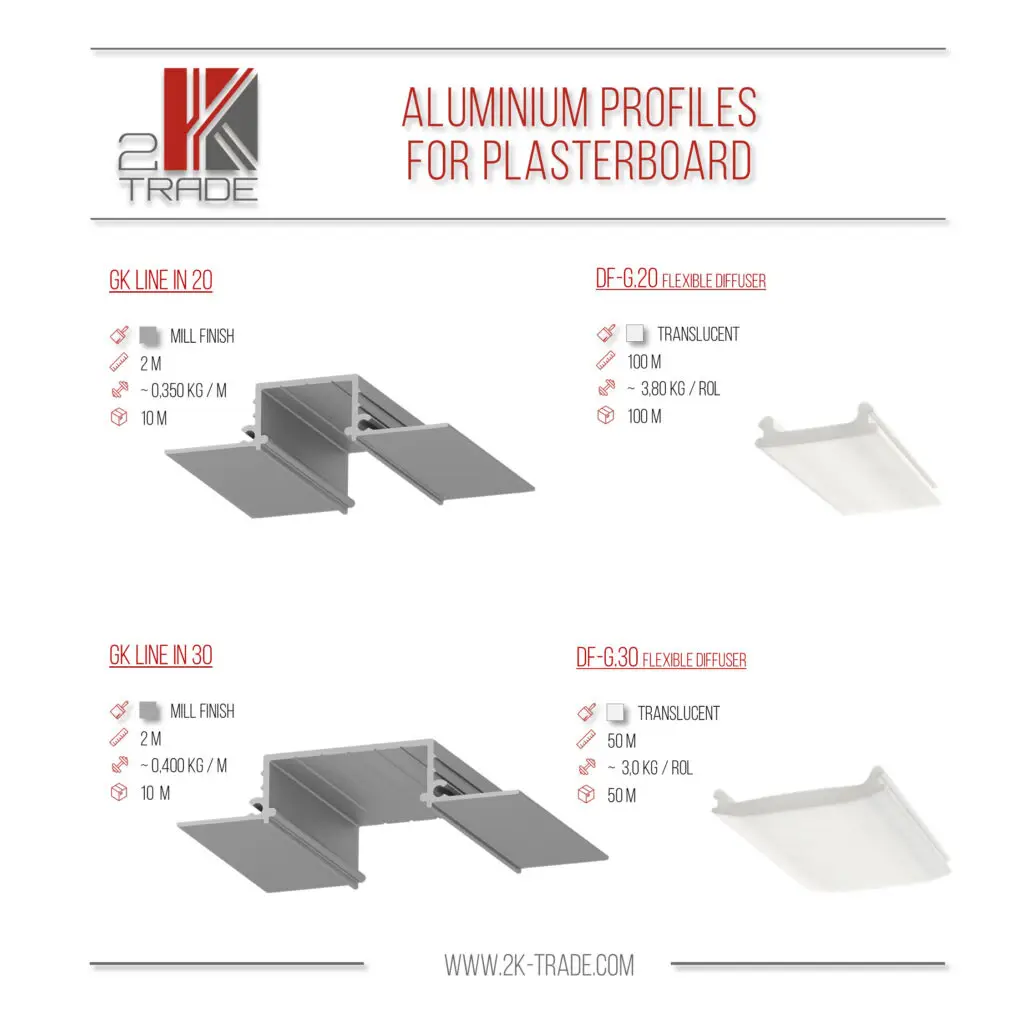
Guide to recessed LED profiles: types (GAMMA series for stretch ceilings, GK LINE

LED aquarium lighting is mounted above the water: an IP20 strip in a
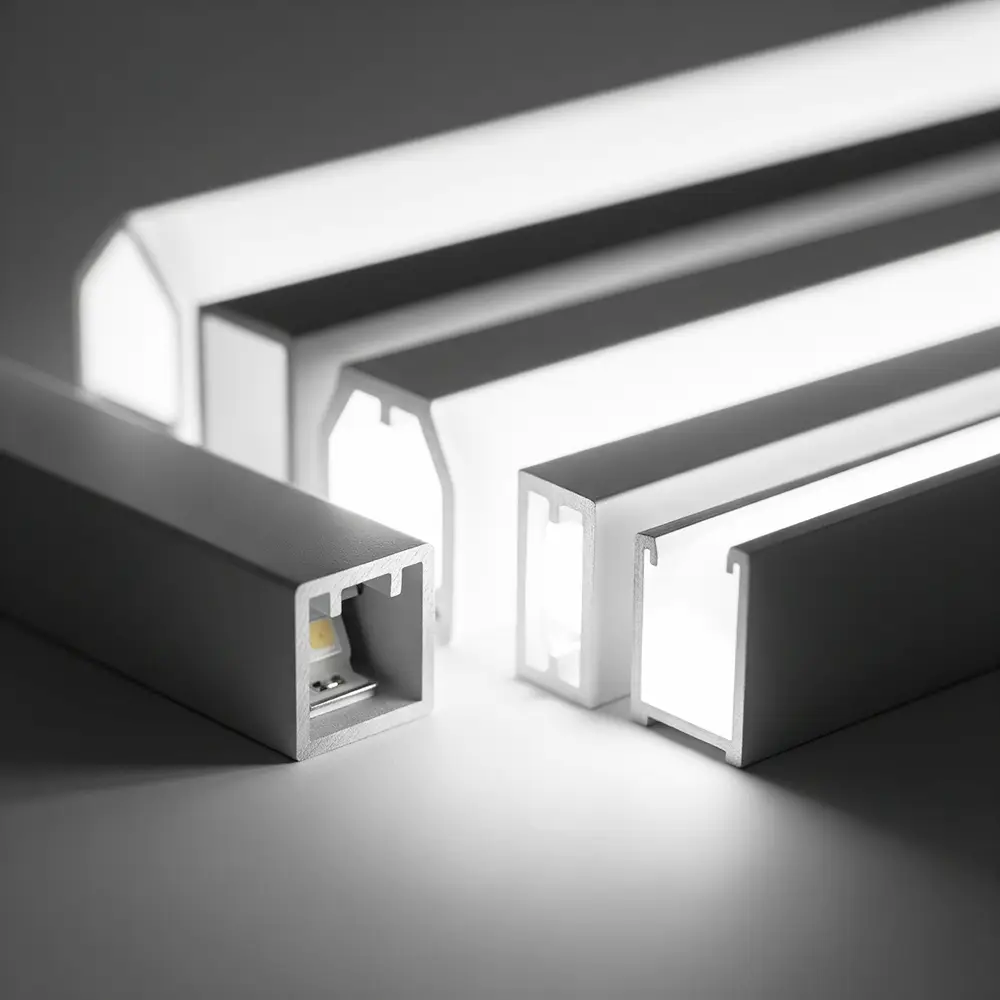
LED ceiling lighting refers to systems using LED strips, modules, or panels installed