Recessed LED Profiles: Types, Installation and Component Selection
Guide to recessed LED profiles: types (GAMMA series for stretch ceilings, GK LINE






06.04.2026 | LED Lighting
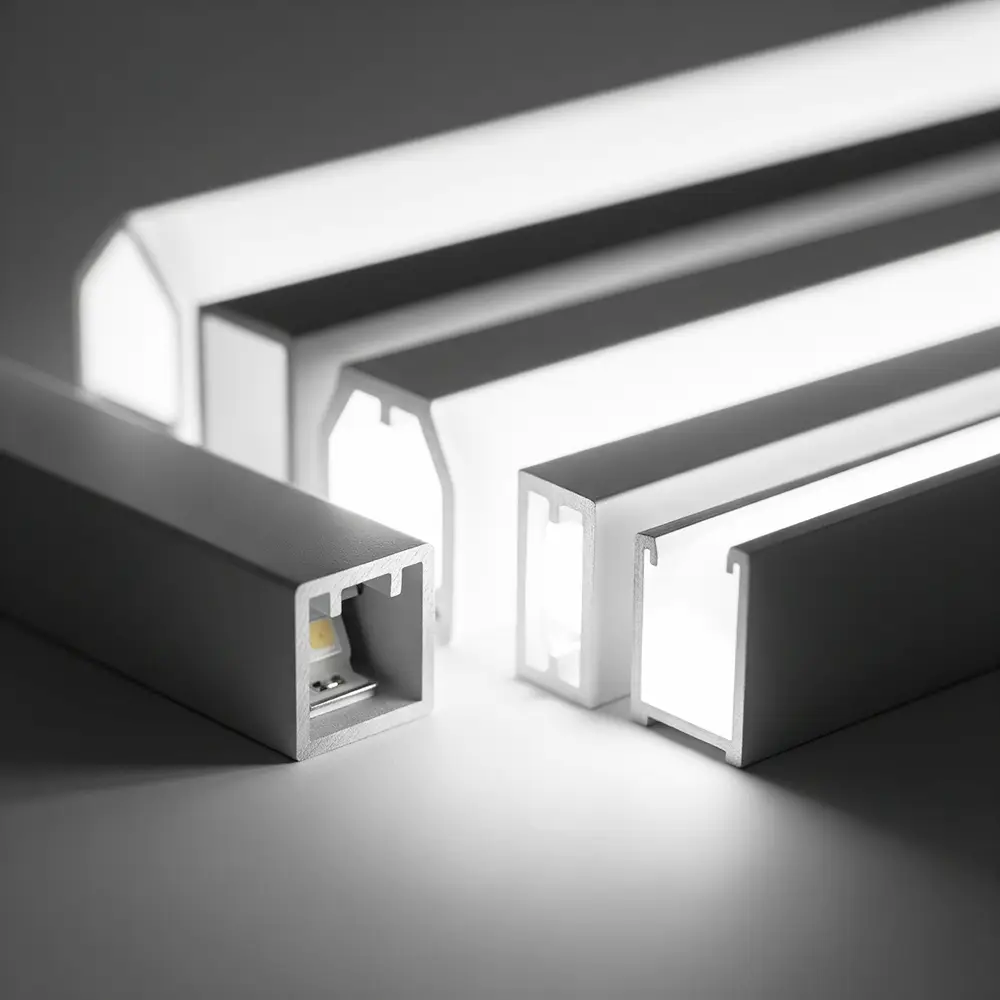
LED strip profiles are aluminium mounting elements that house an LED strip and a cover (diffuser). The profile performs three technical functions: it dissipates heat from the LED strip (heatsink function), protects the strip from mechanical damage and — through the diffuser — diffuses the light, eliminating visible LED dots.
Installing an LED strip without a profile shortens its lifespan because of overheating — the aluminium draws heat away from the diodes and keeps the strip at a lower operating temperature. A bare strip also produces uneven light with visible LED dots, which is unacceptable in professional installations.

LED strip profiles are divided into four main categories depending on the mounting method and the direction of light emission.

Surface-mounted profiles are fixed to the surface of a wall, ceiling, piece of furniture or other structure. They are the simplest to install — fixed with VHB mounting tape or screws. The light is emitted perpendicular to the mounting surface.
Applications: lighting of shelves, cabinets, kitchen worktops, stairs (under the tread nosing), linear lighting along walls.
Recessed profiles are set into a groove (milled slot) in the material — wood, furniture board, plasterboard, concrete. After installation the top surface of the profile is flush with the surrounding material and only the slot with the diffuser is visible.
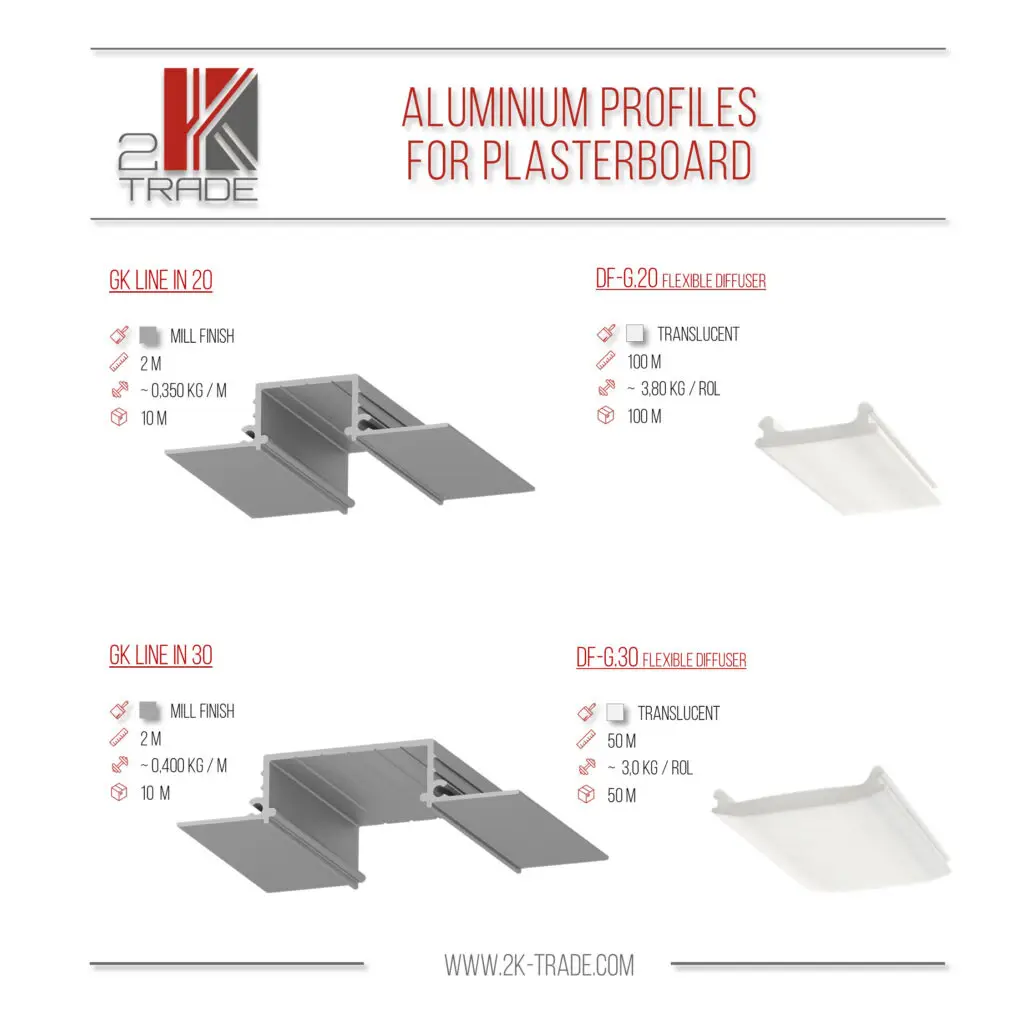
In the 2K-Trade range, the recessed profiles for plasterboard are the GK LINE IN series: GK LINE IN 20 (light slot 20.1 mm) and GK LINE IN 30 (light slot 34 mm). These are the only two models in the series; they are sold in 2 m lengths. GK LINE IN 20 takes the same diffuser as GAMMA 20, so a light line can be carried from a stretch ceiling onto a plasterboard wall.
Applications: suspended plasterboard ceilings, built-in furniture, floors (with a profile rated for higher loads), stairs (in the riser).
Corner profiles are mounted in the corner between two surfaces (e.g. wall and ceiling, wall and floor, two walls). They emit light at a 45-degree angle. A typical cross-section is V- or L-shaped.
Applications: lighting of room corners, light lines at wall-to-ceiling junctions, decorative lighting of furniture edges.
Suspended profiles are fixed to the structural ceiling with steel cables or mounting rods. They form independent light lines suspended in space, emitting light downwards (and optionally upwards). They are used in rooms with high ceilings (offices, halls, galleries).
Applications: open-space offices, reception areas, shopping galleries, high corridors.
The GAMMA series consists of LED profiles designed specifically to work with stretch ceilings. They combine the function of a ceiling mounting profile with an LED channel: the harpoon of the membrane hooks into the profile and the LED strip is mounted in the channel, which is closed with a diffuser. The profiles create a light line around the perimeter of the room or between two ceiling membranes. All models are sold in 2 m lengths.
A note on naming: two systems coexist in the 2K-Trade catalogue. In the CLASSIC and COMFORT mounting profiles the number in the name is the approximate mass of one running metre in grams. In the GAMMA and GK LINE IN profiles the number is the approximate width of the light line or slot in millimetres — not the width of the LED strip. The channel is much wider than the strip: LED strips are 8, 10 or 12 mm wide, GAMMA 30 takes two strips side by side and GAMMA 50 up to three 12 mm strips.
| Model | Light line | LED strips in the channel | Application |
|---|---|---|---|
| GAMMA 20 | approx. 20 mm | 1 strip 8–12 mm | Subtle light line, standard |
| GAMMA 20F | approx. 20 mm | 1 strip 8–12 mm (channel approx. 17 mm) | Version with a mounting flange |
| GAMMA 20 SLIM | approx. 20 mm | 1 strip 8–12 mm (channel approx. 17 mm) | Lower version (height approx. 31 mm) for limited space above the ceiling |
| GAMMA 30 | approx. 30 mm | up to 2 strips side by side (channel approx. 31 mm) | Wider line, COB and RGBW strips |
| GAMMA 30 HP | approx. 30 mm | up to 2 strips side by side | Higher sides: better membrane tension, installation with a double harpoon |
| GAMMA 30 SLIM | approx. 30 mm | up to 2 strips side by side (channel approx. 31 mm) | Lower version of GAMMA 30 (height approx. 31 mm) |
| GAMMA 30.VERT | approx. 30 mm | up to 2 strips side by side (channel approx. 31 mm) | Vertical mounting (wall) |
| GAMMA 50 | approx. 50 mm | up to 3 strips of 12 mm (channel approx. 45.6 mm) | Wide line, intense light |
GAMMA 10 is a separator — the narrowest profile in the series, used to divide two ceiling membranes (e.g. two colours or zones) where a gap without light is required. It is not a lighting profile and no LED strip is mounted in it.
Diffusers (covers) close the profile on the light-emitting side. They serve two functions: they diffuse the light (eliminating visible LED dots) and protect the strip from dust and touch.
Types of diffusers:
For the GAMMA profiles, 2K-Trade offers opal and black diffusers — flexible (DF, made of TPE) and hard (DH, made of polycarbonate), sold in 50 m rolls. The DF-G.20 diffuser fits GAMMA 20, GAMMA 20F and GK LINE IN 20, among others.
The choice of an LED strip profile depends on several factors:
Installing LED strip profiles requires the following rules to be observed:
Every LED profile needs additional elements for a complete installation:
Technically an LED strip can be installed without a profile (on its self-adhesive tape directly on the surface). In professional installations, however, a profile is the standard. Without a profile the strip overheats faster, which shortens its lifespan, the light is uneven (visible LED dots) and the strip is exposed to mechanical damage.
The GAMMA series is intended for stretch ceilings. The standard choice is GAMMA 20 (subtle light line of approx. 20 mm) or GAMMA 30 HP (wider line of approx. 30 mm, room for two strips, higher sides that make tensioning the membrane easier). The profile is fixed to the structural ceiling on steel angle brackets.
A frosted (opal) diffuser scatters the light and eliminates visible LED dots, giving a uniform light line at the cost of part of the brightness. A clear diffuser does not scatter the light — it gives maximum brightness, but the individual LEDs are visible. The frosted diffuser is recommended for most applications. The clear one works well with COB strips, which give uniform light without dots.
Aluminium profiles are corrosion-resistant and can be used outdoors. However, an LED strip with a protection rating of at least IP65 must be used and the joints between the profile and the end caps must be sealed. Anodised profiles are more weather-resistant than raw profiles.
The cost of a set depends on the profile model, the type of diffuser, the chosen LED strip, the power supply and the controller. Current prices of GAMMA profiles, diffusers and LED strips are on the product cards in the 2K-Trade catalogue; a quotation for a specific project can be obtained by contacting the sales department.
The 2K-Trade range includes LED profiles for all types of application:
B2B orders are shipped from the warehouse in Łódź to all of Poland and Europe. Contact us for a quotation and technical advice.
Author: MB 2K-Trade
Guide to recessed LED profiles: types (GAMMA series for stretch ceilings, GK LINE

LED aquarium lighting is mounted above the water: an IP20 strip in a
LED ceiling lighting refers to systems using LED strips, modules, or panels installed