Recessed LED Profiles: Types, Installation and Component Selection
Guide to recessed LED profiles: types (GAMMA series for stretch ceilings, GK LINE






06.04.2026 | LED Lighting
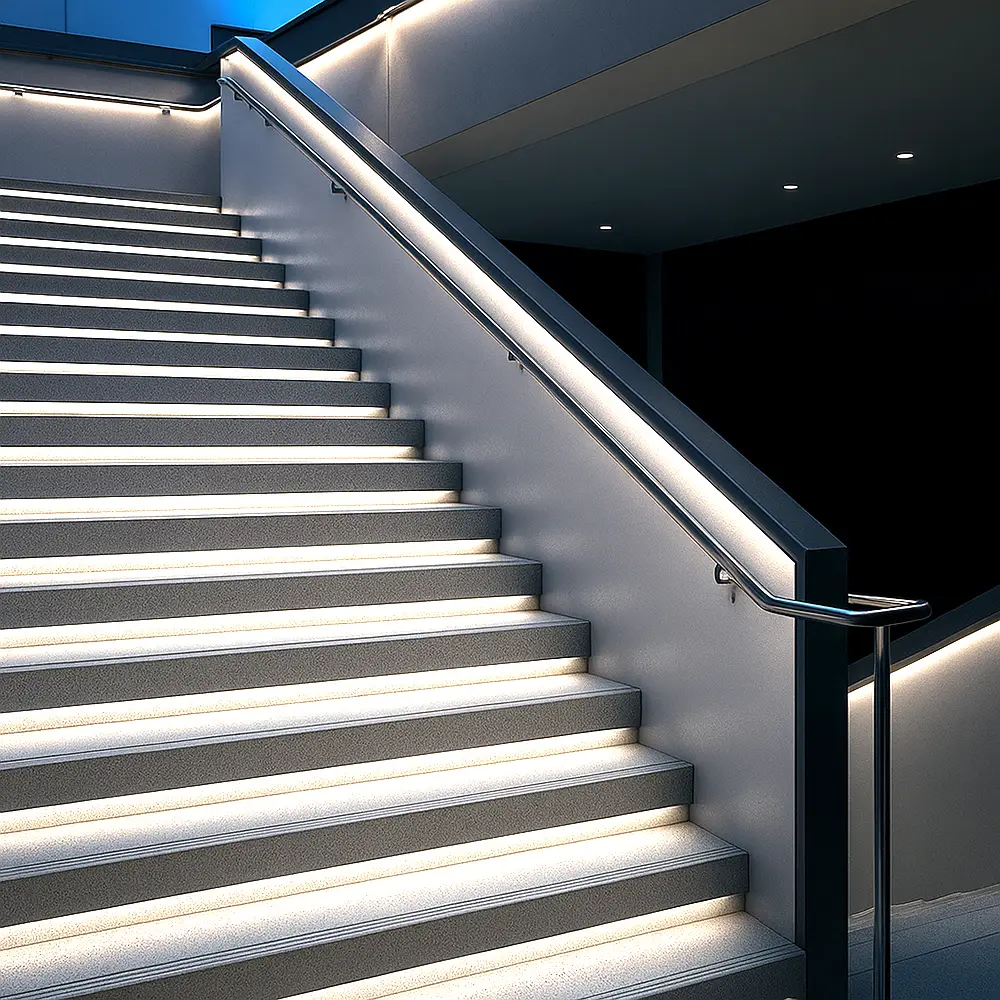
LED stair lighting is one of the most commonly implemented solutions in modern residential and commercial construction. It serves a dual purpose: improving safety (especially at night and in poorly lit stairwells) and enhancing the aesthetic value of the interior. This article covers specific technical parameters, product types, and component selection guidelines for LED stair illumination systems.

LED strips consume between 4.8 W and 20 W per metre depending on LED density and brightness. By comparison, a traditional halogen bulb with similar luminous flux (300-500 lm) consumes 35-50 W. This translates to energy savings of 85-90% while maintaining the same or higher brightness levels.
Modern LED strips have a rated lifespan of 30,000-50,000 operating hours. On stairs, where the light is usually on for only a few hours a day, this means many years of operation without replacement. Additionally, LEDs run much cooler than halogen lamps, which matters when the strip is mounted next to wood, carpet, or plastic.

Choosing the right LED strip depends on three factors: required brightness, light type (white, CCT, RGB), and mounting location (indoor or outdoor). Below is a comparison of the most commonly used types.
| Strip type | LED density/m | Power (W/m) | Application |
|---|---|---|---|
| SMD 2835 ECO 120 LED/m | 120 | 4.8-9.6 | Subtle accent lighting, indoor stairs |
| SMD 2835 140 LED/m | 140 | 9.6-14.4 | Standard stair illumination |
| SMD 2835 Hi-Eff 192 LED/m | 192 | 14.0-20.0 | High-intensity lighting, public spaces |
| COB 320 LED/m | 320 | 10.0-14.0 | Dot-free uniform light, premium look |
| COB CCT 608 LED/m | 608 | 16.0 | Tunable colour temperature, modern interiors |
| COB RGB 576 LED/m | 576 | 14.0 | Decorative colour accent lighting |
COB (Chip-on-Board) strips deliver a uniform line of light with no visible LED dots, which is particularly important in applications with open profiles or clear diffusers. SMD strips are more cost-effective and work well with frosted diffusers.
Colour temperature, measured in kelvins (K), affects how the space feels. Guidelines for LED stair lighting:
| Temperature | Value (K) | Character | Best application |
|---|---|---|---|
| Warm white | 2700-3000 K | Cosy, relaxing | Home stairs, wood, natural stone |
| Neutral white | 4000 K | Natural, clean | Office stairs, concrete, metal, public areas |
| Cool white | 6000 K | Energising, technical | Technical stairs, industrial, garage |
| CCT (tuneable) | 2700-6000 K | Adjustable | Smart home stairs, mood switching |
For most residential projects, the optimal temperature is 3000 K. For modern interiors with concrete or metal, 4000 K works better. CCT strips allow you to change colour temperature via a controller — warmer in the evening (2700 K) and cooler during the day (4000 K).
The IP (Ingress Protection) rating indicates a strip’s resistance to dust and moisture. For stairs, two rules apply:
2K-Trade offers both IP20 LED strips for indoor use and IP65 LED strips for outdoor installations.
Mounting an LED strip directly on the step surface is not a professional solution. An aluminium profile serves three functions: it dissipates heat (extending strip lifespan), protects the strip from mechanical damage, and with a diffuser eliminates visible LED dots.
The choice of profile depends on the installation method:
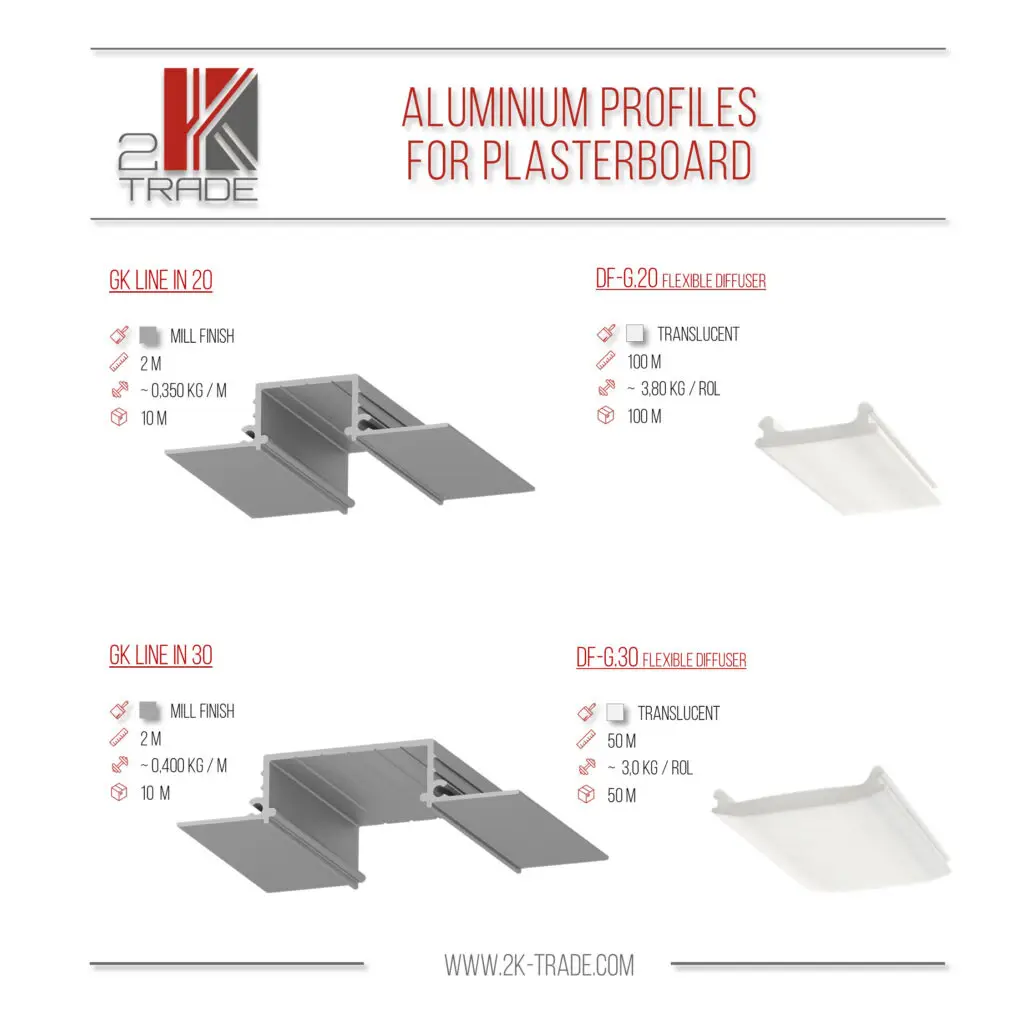
The profiles in the 2K-Trade range are designed for stretch ceilings (the GAMMA series) and for plasterboard constructions (GK LINE IN). There is no dedicated tread-nosing or handrail profile in the range — for that type of installation you need a surface-mounted or recessed profile matched to the strip width (LED strips are 8, 10 or 12 mm wide). If the staircase is clad in plasterboard, GK LINE IN 20 or GK LINE IN 30 can be used for lighting recessed in the wall or in the step.
A complete LED stair lighting system consists of four elements:
All LED strips require 24V DC power (not 230V AC). The power supply wattage must be about 20% higher than the total strip consumption. Example calculation: 15 steps x 1 m of strip x 9.6 W/m = 144 W; with 20% headroom this gives 172.8 W, so a 200 W supply is needed. 2K-Trade stocks Mean Well and Eaglerise LED power supplies from 12 W to 400 W.
A controller enables dimming, colour changes (RGB), or colour temperature adjustments (CCT). For stairs with a motion sensor, a controller with PIR signal input is essential. For smart home integration (Zigbee, Wi-Fi), use wireless protocol controllers.
A PIR (passive infrared) sensor detects motion within 3-8 m range and triggers a step-by-step illumination sequence. A dusk sensor prevents activation during daylight. Together, these components noticeably reduce energy consumption compared to continuous operation.
Proper installation also requires: diffusers (covers) for profiles, connectors and clips for LED strips, power cables, and mounting screws.
Below is a typical installation process for LED lighting on an indoor staircase with 15 steps.
Measure the width of each tread (typically 80-120 cm). Determine the power supply location (max 5 m from the first step to avoid voltage drop). Plan the cable route — usually run in a channel along the wall or beneath the treads.
Cut profiles to tread length (leave 2-3 cm margin on each side). Fix the profile under the tread nosing or in a wall recess using screws or VHB mounting tape. The profile should be positioned so that light is directed at the riser or the floor of the next step.
Adhere the LED strip to the profile channel (strips have a self-adhesive 3M backing). Connect sections with connectors or by soldering. Observe polarity (+/-). Maximum single run length without brightness loss is 5 m — for longer staircases, use dual-end power feeding.
Snap the cover (diffuser) into the profile. A frosted diffuser is recommended for stairs as it distributes light evenly and eliminates glare. A clear diffuser provides higher brightness but may cause visual discomfort.
Connect the cables to the 24V DC power supply, then to the controller and motion sensor. Connect the power supply to the 230V AC mains — this must be done by a qualified electrician. Test the system before closing cable channels.
Indicative material costs (net, B2B) for standard indoor stairs with 15 steps and 100 cm width:
| Component | Quantity | Net cost (EUR) |
|---|---|---|
| LED strip SMD 2835, 140 LED/m, 9.6 W/m | 15 m | 70-110 |
| Aluminium profile with diffuser | 15 m (2 m lengths) | 50-140 |
| LED power supply 200 W, 24V | 1 pc | 30-60 |
| Controller with motion sensor | 1 pc | 35-120 |
| Connectors, cables, accessories | set | 12-35 |
| Total materials | 197-465 |
Premium version with COB strips, Zigbee controller, and black diffuser: EUR 350-700 net. Labour cost (installer/electrician): EUR 120-350 depending on region and installation complexity. All figures are indicative — current prices are shown on the product pages.
Indicative material cost for a standard 15-step staircase is EUR 200-465 net. A premium version with COB strips and a smart controller runs EUR 350-700 net. Add labour: EUR 120-350.
Yes, provided you use strips rated at least IP65. IP65 strips are coated with silicone that protects the LEDs from moisture and rain. For outdoor applications, we also recommend a profile with a seal.
Calculate using the formula: (strip length in metres) x (strip power in W/m) x 1.2 (20% headroom). For 15 m of 9.6 W/m strip: 15 x 9.6 x 1.2 = 172.8 W, so choose a 200 W supply.
Yes, all 24V LED strips can be dimmed using PWM controllers. Zigbee or Wi-Fi controllers allow dimming via a mobile app or voice assistant (Google Home, Alexa). 2K-Trade offers a wide selection of LED strip controllers.
LED strips have a rated lifespan of 30,000-50,000 hours. With a motion sensor (average 2-4 hours/day use), this means many years of operation without replacement. An aluminium heat-sink profile extends this further.
LED strips produce little heat and, mounted in an aluminium profile, warm up only slightly. They are safe for wood, carpets, and plastics. Mounting in an aluminium profile is recommended as it acts as a heatsink.
Installing profiles and LED strips requires no electrical qualifications — it is low-voltage work (24V DC). However, connecting the power supply to 230V AC mains must be done by a qualified electrician. The mechanical installation is fully safe for DIY.
2K-Trade stocks the components needed for professional LED stair illumination:
All products are available at B2B wholesale prices. Contact us for a custom quote for your project.
Author: MB 2K-Trade
Guide to recessed LED profiles: types (GAMMA series for stretch ceilings, GK LINE

LED aquarium lighting is mounted above the water: an IP20 strip in a
LED ceiling lighting refers to systems using LED strips, modules, or panels installed